Two large trials lowered heart-risk markers but not cardiovascular events
In 8,323 adults with cardiovascular disease, monthly pelacarsen cut lipoprotein(a) by 78 percent with no change in time to nonfatal heart attack, stroke, urgent artery-opening or cardiovascular death. In 6,376 adults with atherosclerotic and kidney disease, monthly ziltivekimab cut high-sensitivity C-reactive protein by 64 percent and interleukin-6 by 76 percent; that heart-attack, stroke or cardiovascular-death composite occurred in 561 people assigned the drug and 565 assigned placebo.
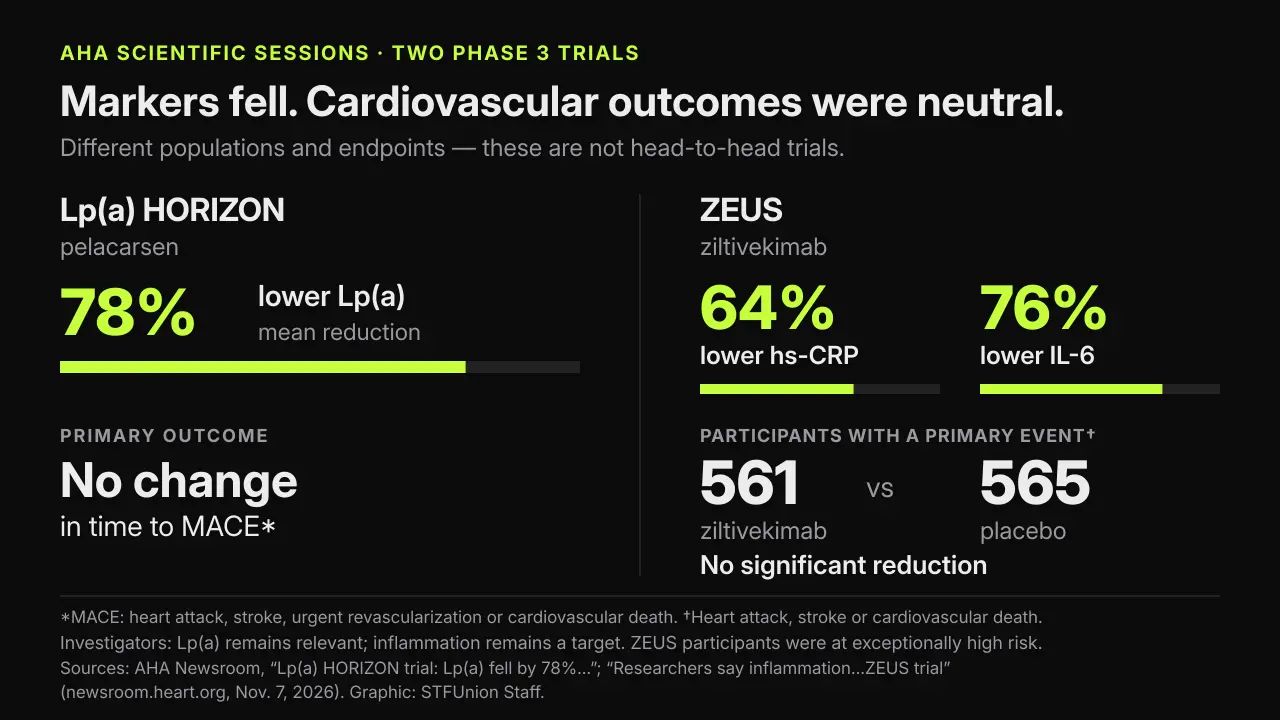
Two phase 3 trials presented November 7, 2026, at the American Heart Association Scientific Sessions cut their target blood markers without reducing cardiovascular events in people. The Association said Lp(a) HORIZON appeared that day in The New England Journal of Medicine and NEJM Evidence, and that ZEUS appeared that day in the Journal.
Novartis-funded Lp(a) HORIZON randomly assigned 8,323 adults with cardiovascular disease and lipoprotein(a) of at least 70 mg/dL to monthly 80 mg pelacarsen or placebo. Lipoprotein(a) fell by a mean of 78 percent, with no change in time to nonfatal heart attack, stroke, urgent revascularization or cardiovascular death. Steven E. Nissen said “it didn’t work” and that there was “not even a trend,” but that this “does not mean Lp(a) is irrelevant” and that measuring it remains “absolutely worthwhile.” Serious adverse events were 37.3 percent versus 41.1 percent; anaphylaxis occurred in 19 people on pelacarsen and none on placebo. In a companion NEJM Evidence analysis, that composite occurred on treatment in 380 people (9.1 percent) on pelacarsen and 434 (10.4 percent) on placebo (hazard ratio 0.98; 0.85 to 1.12).
Novo Nordisk-funded ZEUS assigned 6,376 adults with atherosclerotic disease, kidney disease and high-sensitivity C-reactive protein of at least 2 mg/L to monthly 15 mg ziltivekimab or placebo for a median 29.1 months. Ziltivekimab cut that C-reactive protein measure by 64 percent and interleukin-6 by 76 percent. Heart attack, stroke or cardiovascular death occurred in 561 people on ziltivekimab and 565 on placebo. Serious infections were more common with the drug (20 percent versus 18 percent). Paul M. Ridker said participants “had quite severe disease” and that treatment was likely “too little, too late.” He said earlier work with canakinumab or low-dose colchicine had reduced events, and that it is “important not to overinterpret these findings.”