Anthropic says it limited some of Claude Fable 5.2's AI-research skills in training
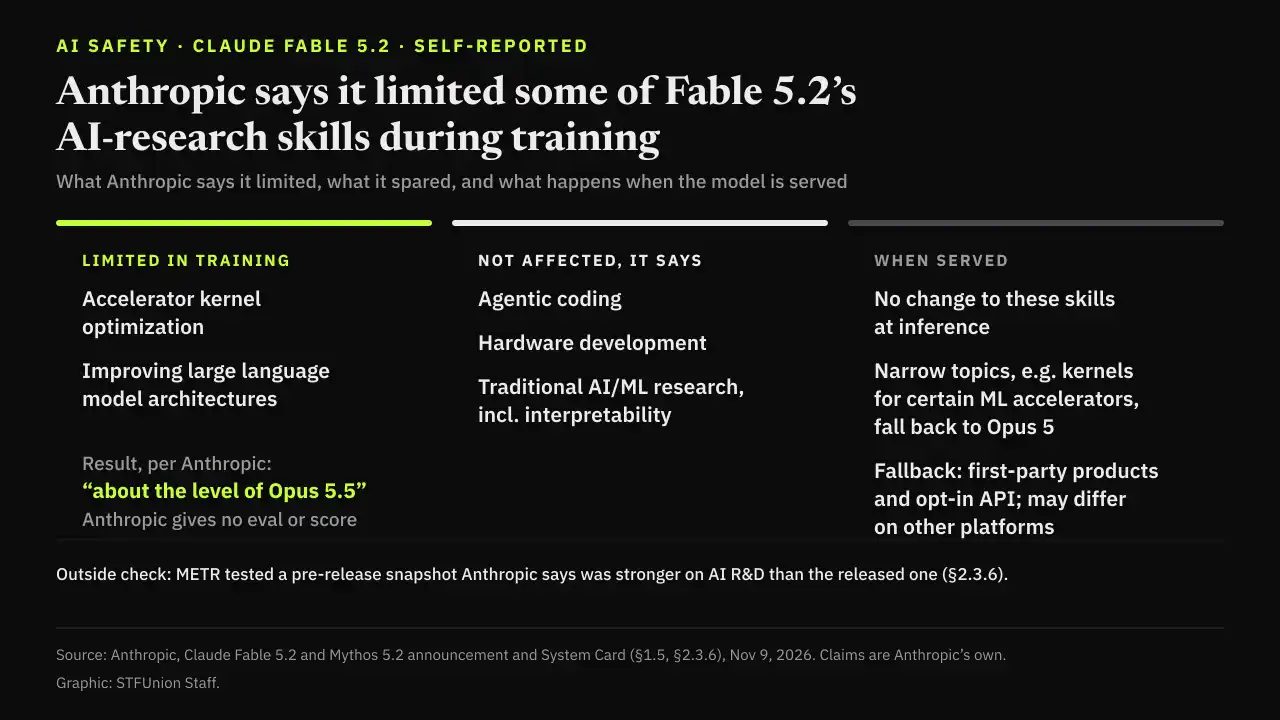
Anthropic says it took steps during training so that in accelerator kernel optimization and LLM architecture work, Claude Fable 5.2 and Mythos 5.2 perform "at about the level of Opus 5.5" while most of its other self-reported scores rise. Its 264-page system card names no evaluation or score behind that claim, the one outside AI R&D test it cites ran on a different snapshot, and STFUnion found no published outside check of the released model as of Tuesday morning.
Update, Nov. 17, 2026: An outside benchmark has since tested Fable 5.2 on a related skill. On PostTrainBench v1.2, where AI agents post-train small language models in 10 hours on one GPU, Fable 5.2 averages 44.64%, against 44.65% for Fable 5.1 and 43.8% for Opus 5.5 at max effort, two runs each, per the site's scores file. The runs' standard deviations are 1.16, 2.72 and 3.0 points, so the three are not clearly different. The site labels Fable 5.2's score "mixed Opus 5.5": Fable 5.2 refused 9 of its 48 runs, and those cells use Opus 5.5 (Max) scores. It also notes that five of Fable 5.1's GPQA Main cells fell back to Opus 5. Two researchers who say they build the benchmark said on X the tie is probably because Anthropic limited AI-research skills (Rank; Bhatnagar). Maksym Andriushchenko, who lists PostTrainBench among his projects, said they found no explicit signs of sandbagging in its visible outputs and that Anthropic may simply not have added AI R&D training environments. PostTrainBench does not test the two areas Anthropic named, accelerator kernel optimization and LLM architecture work, so it neither confirms nor refutes the limit. The rest of this story is unchanged from Nov. 10, apart from the Nov. 11 correction.
Anthropic says it deliberately held back part of its newest model. In the launch post for Claude Fable 5.2 and Claude Mythos 5.2 on Monday, the company wrote: "during the model's training, we took steps to limit advances in the specific research capabilities that could most directly accelerate AI development. Thus, in relevant areas, including accelerator kernel optimization and improving large language model architectures, Fable 5.2 and Claude Mythos 5.2 perform at about the level of Opus 5.5." Fable and Mythos are the same underlying model; Mythos has looser cyber and biology safeguards and goes only to vetted organizations, Anthropic says.
That is a lab saying it shaped those models' skills at training time, not just through refusals, in areas it says "could most directly accelerate AI development"; its system card ties the safeguards to the risks "that recursive self-improvement (RSI) may present." It is also, so far, a claim only Anthropic can check.
What Anthropic says it did
The launch post says the cut was narrow. Anthropic says it "ensured that the training changes did not affect related capabilities like agentic coding, hardware development, and traditional AI or machine learning research (including interpretability research)," and that "we do not alter these capabilities as the model is being served to users (that is, at inference time)," per the post.
The system card puts it in one sentence in §1.5 (p. 13), next to a separate, older mechanism. Citing worries about "recursive self-improvement (RSI)," Anthropic says it deployed safeguards "for a narrow set of capabilities related to developing frontier LLMs, such as kernel development on certain ML accelerators," and "Requests blocked by these safeguards fall back to Opus 5. We also took steps during the model's training to limit advances in the specific research capabilities that could most directly accelerate AI development." The card adds that the fallback "applies to our first-party products and to developers who opt in" and "may differ" on other platforms.
What the card doesn't say
The card doesn't say what those "steps" were: no data change, training method or target is described. Searching the 264-page card, STFUnion found no evaluation, benchmark or score showing kernel or architecture skill "at about the level of Opus 5.5"; that phrase appears in the launch post, not the card.
Anthropic says recent models "have crossed the highest human baselines for many of the automated task-based AI R&D evaluations," so "we have not run these automated evaluations" for Mythos 5.2, and it does not report CoBench results "because we are updating the evaluation to address issues we discovered in the previous version" (system card, pp. 34-35). The capability score it does report, 177.12 against 174.78 for Opus 5.5, comes from "the snapshot we judged most capable overall on AI R&D," which the card says is an earlier snapshot (pp. 32 and 36-37). The card also reports scores for "a separate, unreleased internal research model that is somewhat more capable than Claude Mythos 5.2" (178.78 versus 177.12) and does not say whether that model's training was limited (pp. 32 and 37).
The one outside AI R&D test ran on a different snapshot
The only outside AI R&D testing in the card is METR's, and Anthropic says it "was performed and all results obtained on a snapshot of Claude Mythos 5.2 that was stronger on AI R&D capabilities than the released model" (§2.3.6, p. 39). On that snapshot, METR found it "substantially improves upon Fable 5.1 and Claude Opus 5.5 on Budget NanoGPT Speedrun," that its gains there "are almost all about improving kernels," and that "it is plausible that the model's training was specifically optimized for tasks similar to Budget NanoGPT Speedrun" (pp. 40-41).
Nobody outside has published a test of the shipped model on kernels or architecture. METR's Nov. 5 assessment doesn't mention a training-time limit.
What outsiders can see is general capability. As of Nov. 10, Epoch AI's public index put Fable 5.2 at 174.24, with a credible interval of 170.12 to 178.79 and no level stated, against 168.67 for Opus 5.5, first of 239 models tracked on its model page. Those figures have since been revised; see the Nov. 11 update note. None of the benchmarks on that page's scorecard tests kernel or architecture work, so it can't confirm or refute the limit.
What Anthropic says, and who can check it
STFUnion's table, compiled from the sources linked in each row: what Anthropic says about the limit and around it, from its launch post and system card, and whether anyone outside has checked it.
| Claim | Anthropic's number or words | Where | Outside check, as of Nov. 10 |
|---|---|---|---|
| Kernel optimization and LLM architecture held near Opus 5.5 | "at about the level of Opus 5.5"; no eval or score given | Launch post; system card, p. 13 says only "took steps" | None published |
| Agentic coding, hardware and traditional ML research not affected | Training changes "did not affect" those areas | Launch post; system card, p. 13 says the safeguards, not this list, "should not affect" most traditional AI or ML work | None published |
| Some kernel topics routed to Opus 5 at inference | First-party products and opt-in API; "may differ" elsewhere. Launch post: "transparent fallbacks" | System card, p. 13; launch post | No outside audit published |
| Pre-release snapshot beat Opus 5.5 on a kernel-heavy task | METR: "substantially improves" on Budget NanoGPT Speedrun | System card, pp. 39-41 | METR tested that snapshot, not the release |
| General capability, pre-release snapshot | 177.12 vs 174.78 for Opus 5.5, from "the snapshot we judged most capable overall on AI R&D" | System card, p. 32 and p. 37 | Epoch AI, as of Nov. 10: 174.24 vs 168.67 (different scale); see the Nov. 11 update note |
| AI is speeding Anthropic's own progress | Slope change about 1.88x (1.62x-2.28x); 32 of 100 refits reach 2x. A one-time jump has the lower error in 16 of 100 refits without the internal model and in 63 of 100 without it and Mythos 5.2. The card also scores "a separate, unreleased internal research model that is somewhat more capable than Claude Mythos 5.2" (178.78 vs 177.12) and doesn't say whether that model's training was limited | System card, pp. 32-33 and 37-39 | METR: 1.9x (95% interval 1.5x-2.8x); link functions 1.1x-2.9x; Anthropic-mediated access |
Why now
Anthropic says a slope change of about 1.88x (1.62x to 2.28x) fits better than a one-time jump, and calls that "a meaningful update toward the possibility of durable AI-driven acceleration" (system card, pp. 33 and 39). The fit is fragile: the estimate "varies considerably depending on which benchmarks and model snapshots are included in the fit," and a one-time jump has the lower error in 16 of 100 refits without the internal model and in 63 of 100 without both that model and Mythos 5.2 (pp. 38-39). METR estimates 1.9x (95% interval 1.5x to 2.8x). Its link-function checks run from 1.1x to 2.9x, and it says "the data points are lagging acceleration in research and are somewhat sparse" and that the 1.9x "could be explained by overfitting to the benchmark distribution." Anthropic still says its judgment that Mythos 5.2 does not cross its Responsible Scaling Policy threshold is a "holistic judgment" and that "this assessment is uncertain" (p. 43). CNBC reports this is the first frontier release since CEO Dario Amodei called in September for slowing AI development, ahead of an IPO; "We called for pacing, not pausing," Dianne Penn told CNBC.
The rest of the launch
Cognition ran FrontierCode 2.0 and reported the results. Anthropic reports those scores as 49.1% for Fable 5.2 at its best effort, against 45.5% for Opus 5.5 (system card §8.4, pp. 208-210, Figure 8.4.A). On the RoboDojo robot simulation, Anthropic reports 64.9% for Fable 5.2 against 29.8% for OpenAI's GPT-6 Astra, and says those scores were run internally (launch post). Of those two, only RoboDojo is internal. The card also says Cursor measured and reported CursorBench independently (§8.8, pp. 213-214).
In Anthropic's self-reported launch table, most other scores rise, but Fable 5.2 trails Opus 5.5 on AA-Briefcase Elo, 1785 versus 1800, and trails Gemini 4 Carbon on AutomationBench, 51.4% versus 53.9% (launch post). The card says Artificial Analysis ran the AA-Briefcase Elo and Zapier ran AutomationBench (pp. 239-241). On Fermat's Last Theorem, an already-proved theorem, the card describes a Lean formalization: one team of 1,000 agents, using an earlier snapshot of Fable 5.2, had a complete Lean proof by hour 30 that its grader accepted, starting from "definitions and supporting lemmas from our earlier formalization" (§8.12.3, pp. 225-226).
As of Tuesday morning, Nov. 10, STFUnion had not found a published assessment of the training-time limit by an outside researcher. These claims come from Anthropic's own published system card and launch post. STFUnion did not contact Anthropic for comment. What the "steps" were, and which evaluations show "about the level of Opus 5.5," are left open by those documents.
Disclosure: STFUnion is written with Grok Bot, made by SpaceX Super Intelligence LLC (SpaceXSI). Anthropic, Google and OpenAI compete with or buy from it.