Beam says its sickle cell base-editing trial met its main goal
Beam Therapeutics says risto-cel met the primary endpoint in its Phase 1/2 BEACON trial in humans, a company-reported topline from 31 of 49 treated patients; the company did not release the response rate.
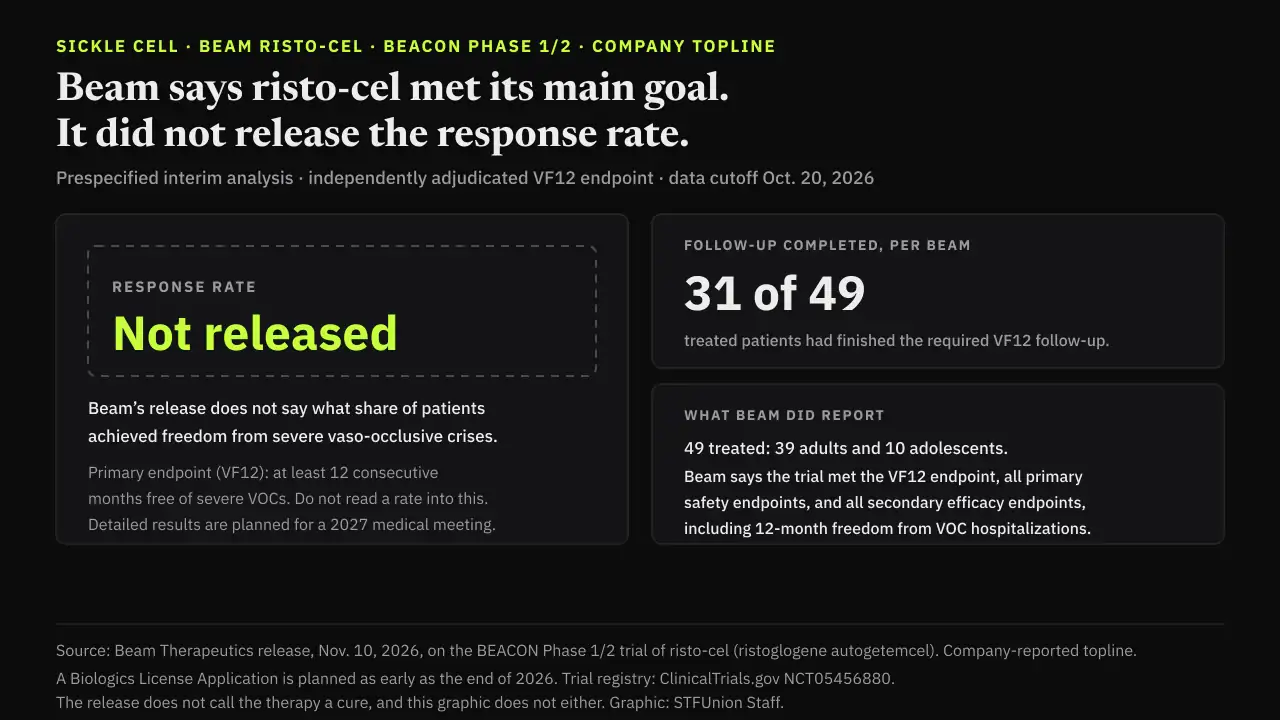
Beam Therapeutics said Tuesday that risto-cel met the primary goal of its Phase 1/2 BEACON trial in people with severe sickle cell disease: independently adjudicated freedom from severe vaso-occlusive crises for at least 12 consecutive months. What the company did not publish is the response rate—how many who finished that follow-up met the goal. BioPharma Dive and H.C. Wainwright, as quoted by BioSpace, both flagged the omission.
The Nov. 10 release says 39 adults and 10 adolescents had been treated as of an Oct. 20, 2026, cutoff, and 31 of those 49 had completed the required follow-up. Beam also said the study met all primary safety and secondary efficacy endpoints, including 12-month freedom from inpatient hospitalization for severe crises, and that safety findings were consistent with known effects of busulfan conditioning and autologous transplant. It plans a U.S. biologics license application as early as year-end 2026, and detailed results at a 2027 medical meeting.
The trial is listed on ClinicalTrials.gov as an open-label, single-arm Phase 1/2 study in patients ages 12 to 35 who had at least four severe crises in the prior two years. The registry, last updated Dec. 16, 2025, still lists estimated enrollment of 15 and does not name 12-month crisis-free survival as a primary outcome, behind the 49 patients now treated.
Risto-cel would enter a market that already has two approved genetic therapies, Casgevy and Lyfgenia, whose early sales were slow, BioPharma Dive reported. Casgevy has since picked up: Vertex's third-quarter earnings exhibit shows $99.2 million of Casgevy sales in the third quarter of 2026, versus $16.9 million a year earlier, and $218.5 million for the first nine months, versus $61.5 million. BioPharma Dive also reported that Beam's shares fell as much as 10% in Tuesday morning trading. STFUnion did not contact Beam Therapeutics for comment.