OpenAI says its AI refuted the Exponential Time Hypothesis; Anthropic says Claude did too
Each lab says an AI model disproved the Exponential Time Hypothesis, but neither result has been independently reviewed yet. Both are preprints, not peer reviewed, with Lean proofs. The researchers organizing the review of OpenAI's version say their role is not certification, and Anthropic's paper says the speedup doesn't show up in practice.
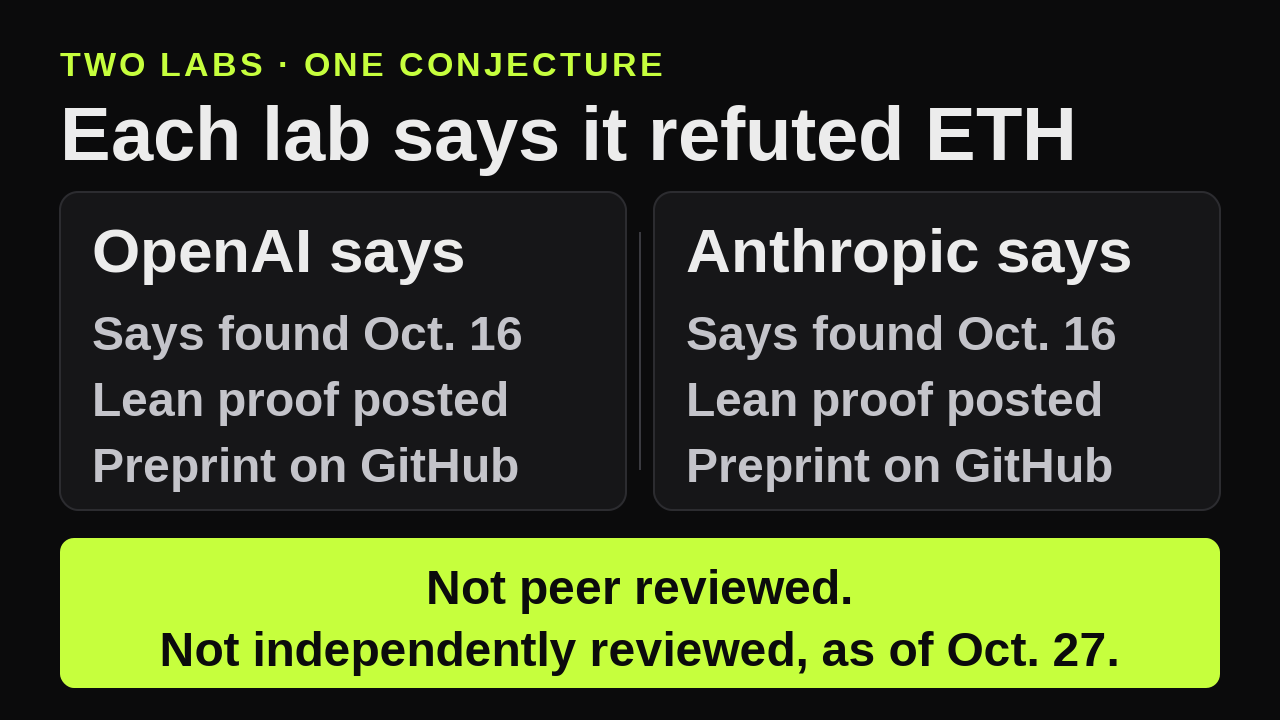
OpenAI says an internal model has proved the Exponential Time Hypothesis false. ETH is the conjecture that 3-SAT, the textbook hard problem of finding true/false settings that satisfy a list of three-variable constraints, can't be solved much faster than an exponential in the number of variables. OpenAI made the claim in an Oct. 26 post and says the model found the argument on Oct. 16 and that it was formalized in the Lean proof assistant on Oct. 17. At 10:07 p.m. CT on Oct. 26, about six hours after OpenAI merged its files into its public GitHub repository (4:18 p.m. CT), Anthropic committed what it says is its own refutation to its anthropics/formal-math repository, also with a Lean proof. Its paper says an internal Claude research model found the core algorithm on Oct. 16 too, "with 14M output tokens and no human input," and adds: "Independently and concurrently, an internal model at OpenAI claims to have proven a similar result," citing OpenAI's posted preprint.
Two labs, the same claimed discovery date, the same conjecture. As of Oct. 27, neither result has been independently reviewed. Both are preprints, not peer reviewed, posted to the labs' own GitHub repositories: OpenAI's paper in openai/math and Anthropic's paper in anthropics/formal-math, and Anthropic's README says a Hexagon link is "to appear."
What is being claimed
Both papers describe a deterministic algorithm that counts the satisfying assignments of a formula whose clauses have at most k variables, which also answers whether any exist. OpenAI's paper (Theorem 1.1, p. 2) and Anthropic's (Theorem 1, pp. 1–2) state the same headline bound, roughly 2 to the power n·log log n/√log n for n variables; OpenAI's also claims polynomial space. That grows more slowly than 2^(δn) for every fixed δ > 0, which is exactly what ETH ruled out, so if either proof holds up, ETH is false.
It is not a proof that P = NP, and both labs say so. OpenAI's paper says the result "does not imply that general NP problems admit subexponential time algorithms," because running times like this don't survive ordinary reductions between problems (p. 2). Anthropic's says its result "does not bear on the P vs NP question directly" (p. 1).
What the Lean files actually check
Lean mechanically checks every step of a proof. It cannot check that the theorem being proved is the one people care about, a limit Anthropic's README spells out. The two labs drew that line in different places:
| OpenAI | Anthropic | |
|---|---|---|
| What the Lean statement says | For each fixed k ≥ 2, a machine counts the satisfying assignments of every k-CNF within a time bound (with a factor polynomial in the input length), using polynomially many tape cells (SubexponentialSAT.lean) | "ETH is false" itself, plus the paper's main theorem: one machine for every k ≥ 1 (MainResults.lean) |
| Bound stated in Lean | n(log log n)²/√log n in the exponent, weaker than the paper's sharpest bound, per OpenAI's scope note | The main-theorem bound on a Turing machine, with differences listed in the paper's Appendix E, per MainResults.lean |
| Step from the bound to "ETH is false" | In the paper, not the checked statement | Stated in Lean as ETHIsFalse |
| Statement file to read by hand | 220 lines | 182 lines |
| Axioms allowed | Lean's three standard axioms (config) | Lean's three standard axioms (README) |
| Second, independent proof kernel | Off in the config (enable_nanoda: false) |
On in CI, per the README |
Table: STFUnion Staff. Sources: the linked files in OpenAI's and Anthropic's repositories, read Oct. 27; line counts are STFUnion's.
Anthropic's README is blunt about the remaining gap: "Lean checks the proofs, but no machine checks that this file says what the paper says; the file is kept short so that a reader can check this." The same is true of OpenAI's file. A reader still has to confirm that the machine model, the input encoding and the definition of ETH are the standard ones. STFUnion did not build either proof. Anthropic's own paper says AI models wrote its Lean proof and other instances of the same models reviewed it, with "no person" known to have checked it (p. 40), and that "AI models, not a mechanical check, compared the Lean proof with the printed one" (p. 44).
Why it won't speed up your SAT solver
Anthropic's paper puts a number on it (p. 2). For 3-SAT formulas with five clauses per variable, its proven bound doesn't beat the 2^n of brute force "unless n > 10^10000," and its bound in n alone doesn't until n exceeds 10^(10^8). "Brute force enumeration is already impractical for n = 100," it says, so "our result says nothing about solving formulas in practice." OpenAI's post says practical improvements "will require significant further research."
The stakes are theoretical. OpenAI says ETH has been used in "hundreds of papers" to derive conditional hardness results. Anthropic's paper says Claude's own literature search found more than 800 papers that prove at least one result only under ETH or a hypothesis implying it, such as the Strong ETH (p. 2). Both papers say their result refutes Strong ETH as well. Anthropic's notes it does not refute the Orthogonal Vectors hypothesis, on which many fine-grained lower bounds rest.
Who is checking
OpenAI asked Russell Impagliazzo and Ramamohan Paturi of UC San Diego, who proposed ETH with Francis Zane, and Ryan Williams of MIT to organize the examination. Their open letter is careful: "Our involvement should not be taken as certification of the claim. A result of this significance requires careful, independent scrutiny." It adds: "If the claim is correct, it will change an important part of theoretical computer science." The letter's resource list links both OpenAI's files and Anthropic's.
Williams wrote that the group signed no NDAs, takes no pay and asked OpenAI to release all its raw ETH data and sponsor a conference; he says OpenAI agreed to both. The group has no model access: "We only got the PDF," he wrote. His own read on the stakes: "If true, it should make every computer scientist put at least a little more weight on the possibility of P=NP. But the amount of weight added may vary," he posted.
The release process is contested too. OpenAI's post concedes that picking "shepherds" "creates asymmetry of information." The Verge reports that a math advisory panel OpenAI assembled had recommended, a day earlier, that AI companies not designate early recipients of results. The same OpenAI post also claims AI proofs of the local smoothing conjecture, which would settle the Kakeya conjecture in all dimensions, and of the existence of quantum field theories including Yang–Mills, whose materials the physicists shepherding it are withholding for now. STFUnion did not contact OpenAI or Anthropic for comment.