FDA writes its 2024 AI Pap-test imager decision into federal rules
An FDA final order published Nov. 5 codifies the Class II category it created for Hologic's Genius Cervical AI in January 2024. The AI picks cells for a human to review; a human makes the diagnosis. Per the order, similar devices can now use the less burdensome 510(k) route.
The FDA didn't approve anything new today. A final order in the Federal Register, effective Nov. 5, adds 21 CFR 864.3900, "digital cervical cytology slide imaging system with artificial intelligence algorithm," as a Class II device with special controls. The classification has applied since Jan. 31, 2024, when FDA granted Hologic's De Novo request for its Genius Digital Diagnostics System with the Genius Cervical AI algorithm. What changes is the paperwork lane: per the order, similar devices can now use the "less burdensome 510(k) process" with Genius as a predicate.
The rule describes an assistant, not an autonomous reader. The order says the AI selects "areas of interest to facilitate interpretation by the reader," and labels must say the user reviews the entire gallery before diagnosing. Its Table 1 names the two risks: false negatives and false positives from device errors, and from users misreading images or misusing the device. The mitigations are validation studies, labeling and training, plus a cap on daily slide workload set from clinical screening-time data.
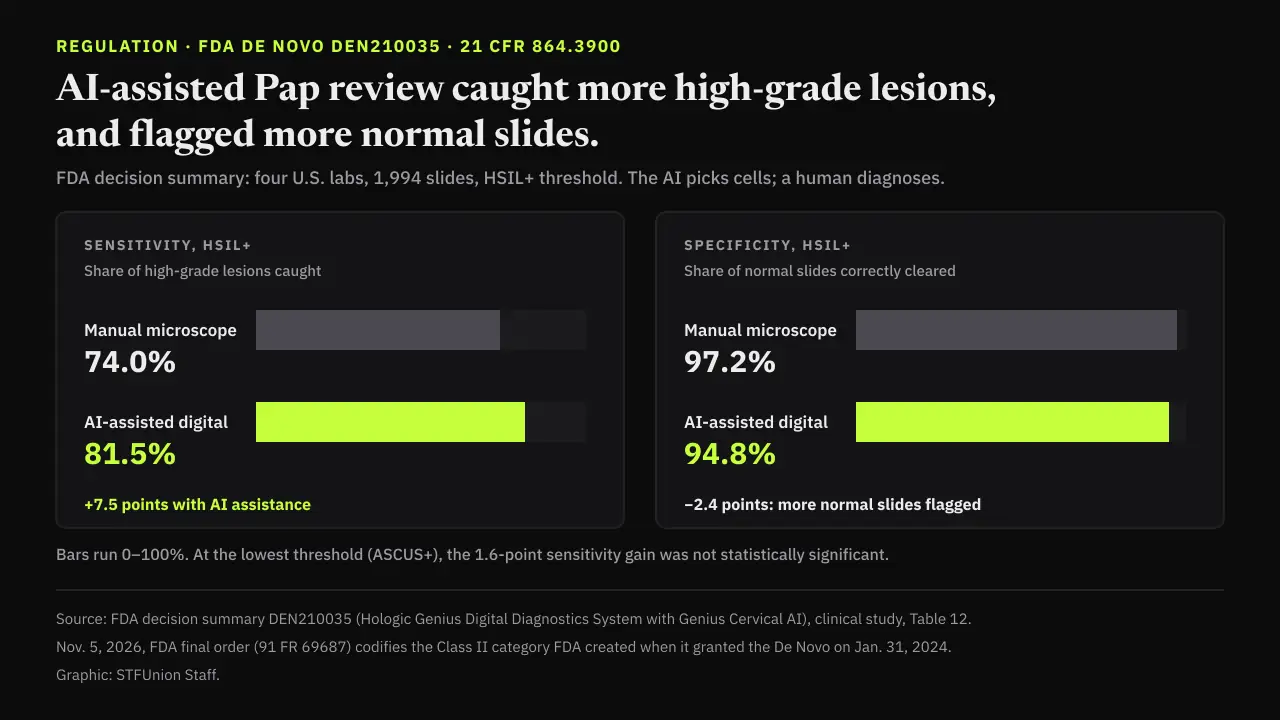
What the order leaves out is the trade-off. In FDA's decision summary, a four-lab U.S. study of 1,994 slides found AI-assisted digital review caught more high-grade lesions (HSIL+) than manual microscope review, 81.5% versus 74.0% sensitivity. But specificity fell from 97.2% to 94.8%, so more normal slides were flagged. At the lowest threshold (ASCUS+), the sensitivity gain of 1.6 points wasn't statistically significant.