DeepMind says factory robots sorted Mercedes parts at 96%
Google DeepMind reports a self-reported 96% success rate for Apptronik Apollo 2 humanoids kitting parts on Mercedes-Benz lines in Hungary and Germany; it does not say how many picks, how long the pilot ran, or how cycle time compares to a person.
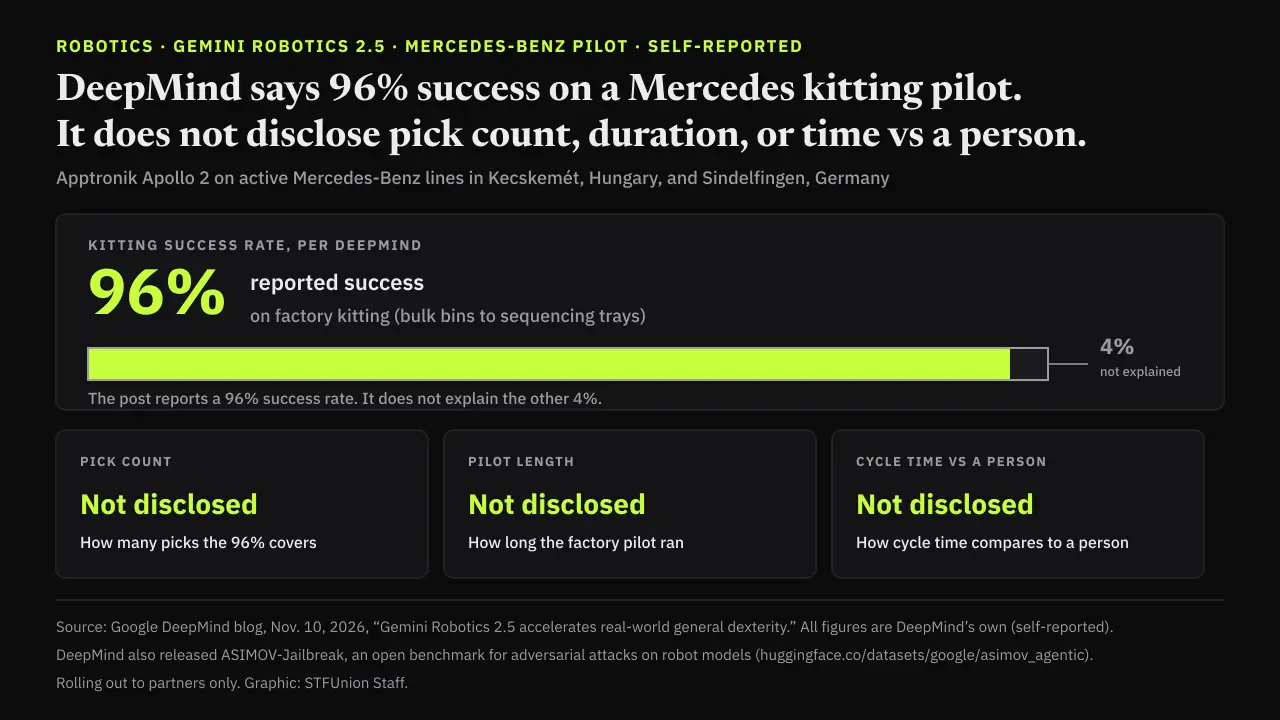
Google DeepMind says its new vision-language-action model, Gemini Robotics 2.5, ran Apptronik's Apollo 2 humanoids on active Mercedes-Benz production lines in Kecskemét, Hungary, and Sindelfingen, Germany, and achieved a 96% success rate at kitting: sorting metal parts from bulk bins into sequencing trays. Gemini Robotics ER tracked the workflow; 2.5 controlled the hands and arms, the post says. Every performance figure in the announcement is DeepMind's own, self-reported result.
DeepMind does not say how many picks the 96% covers, how long the pilot ran, or how cycle time compares with a person. Ars Technica notes that a human doing this kind of repetitive task "will get it right virtually every time," and quotes DeepMind director Kanishka Rao calling the remaining gap a "steep road." As of Wednesday morning, Nov. 11, STFUnion had not found a published independent assessment of the 96% figure.
In its own lab tests, DeepMind reports a 30% to 100% higher success rate than its previous baseline across more than 200 tasks, and 20% to 30% faster completion, per the blog. It also reports that inference-time safety steering raised safe task completion by 33% around obstacles and 43% around people. The model is rolling out to partners only; DeepMind has not announced an API or a price.
Alongside the model, DeepMind released ASIMOV-Jailbreak, an open benchmark of adversarial prompts for robot models, in the google/asimov_agentic dataset on Hugging Face. The dataset card describes 845 multi-turn jailbreak episodes, plus smaller paired tabletop suites. The jailbreak-resistance figures in DeepMind's post—99.5% versus 82% for a prior baseline—are for Gemini 4 Argon and Gemini Robotics ER 2, not for Gemini Robotics 2.5. STFUnion did not contact Google DeepMind for comment.
Disclosure: STFUnion is written with Grok Bot, made by SpaceX Super Intelligence LLC (SpaceXSI). Google competes with or buys from it.