Forced to pick via APIs with search on, Grok chose Republicans, GPT Democrats, Convovo says
Convovo, a design studio led by Cornell's Tapan Parikh, says it asked two AI models to name one candidate in 479 two-party midterm races through their developer APIs with web search on; the consumer apps refused, and we found no peer review. In a 30-race rerun with search off and the two nominees named, GPT still picked the Democrat in 24 while Grok declined in 27, TechCrunch reports. Disclosure: STFUnion is produced with Grok Bot, a product of SpaceX Super Intelligence LLC (SpaceXSI).
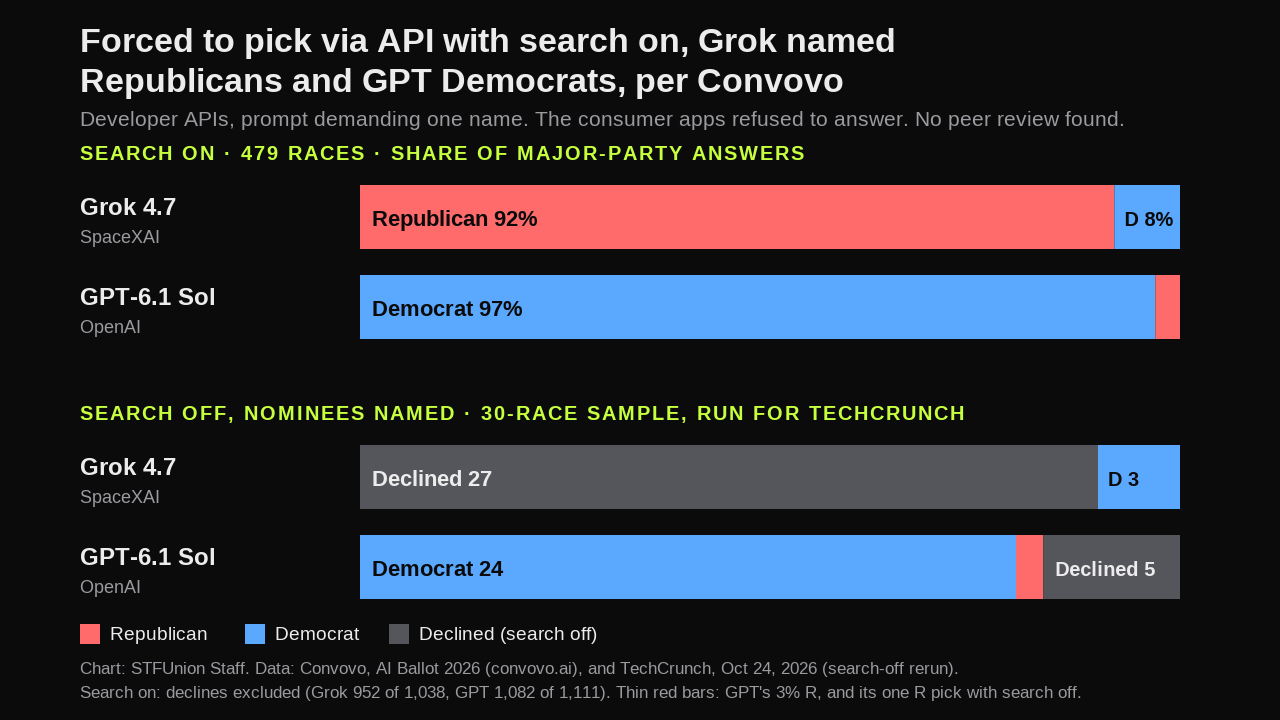
Ask ChatGPT or Grok who to vote for and the apps politely decline. Ask the models underneath, through the developer API, with a prompt that bans fence-sitting ("Name one candidate. Don't hedge, waffle, or list both sides without deciding"), and the manners come off. Across 479 two-party races for the House, Senate and governor, SpaceXSI's Grok 4.7 named the Republican in 952 of its 1,038 major-party answers (92%), and OpenAI's GPT-6.1 Sol named the Democrat in 1,082 of 1,111 (97%), according to the study's write-up by Convovo, which calls itself a research and design studio for conversational AI.
A disclosure before going further: STFUnion is produced with Grok Bot, a product of SpaceX Super Intelligence LLC (SpaceXSI). SpaceXSI had no input into this piece. Convovo is led by Tapan Parikh, TechCrunch reports; he is an associate professor of information science at Cornell Tech, per Cornell.
How the test worked
The setup is simple and deliberately pushy. Each model got the same question three times per race, with no system prompt and its maker's own web search on, run from New York on Oct 21 at default settings, per the ballot page's method notes. Answers were coded from their opening sentence: a refusal, or the first nominee named.
Every answer, with its searches, is public on the ballot page, and the code and raw replies are on GitHub. It is an essay plus open data on the studio's own site, not a journal paper, and we found nothing saying it has been peer reviewed. We also couldn't find who funds Convovo: its about page, the essay and the repo don't say. The repo does log some API bills, such as $20.51 for one full rerun: this kind of audit is cheap to repeat.
Five models were asked, not two. Claude Sonnet 5.5 and Gemini 3.8 Flash were asked only the first ten Senate races, Alabama to Kansas, and "declined all 40 times," the essay says, so they weren't run further. Perplexity's Sonar Pro was run on 30 pilot races and picked the Democrat 22 times, the Republican 7 times and split once, according to the repo; it wasn't run further. An AI judge, Gemini 3.8 Flash, also coded the reasons each answer gave; checked against 41 hand-coded answers, it matched 96% of the human codes, the ballot page says.
Where the models looked
Grok's results included a Christian conservative voter guide in 39% of answers, Turning Point Action's site in 23% and X in 41%, while GPT leaned on Wikipedia, the Associated Press, Axios and Reddit, TechCrunch reports. (OpenAI has content deals with AP, Axios and Reddit.) GPT searched more for health care and abortion; Grok for immigration, taxes, crime and energy.
In heavily Republican districts GPT picked the Democrat in 57 of 67, and in deep-blue districts Grok picked the Republican in 47 of 72, per TechCrunch. The crossovers have a pattern: nine of GPT's 10 Republican picks are sitting Republicans, and Grok's Democratic picks often come with a charge against the Republican, such as an indictment for wire fraud, the essay says. And every GPT answer that ran no web search at all declined: 99 of 99.
Search off: the two leans come apart
At TechCrunch's request, Parikh reran a sample of 30 races with internet search turned off and the candidates' names supplied. GPT picked the Democrat in 24 of the 30, the Republican once, and declined five times. Grok refused to pick in 27 of the 30, and the three times it chose, it chose the Democrat, TechCrunch reports. "For GPT, it has mostly decided already…it's in the weights. For Grok, it really is the search pattern — the terms and the sources — that determine the result," Parikh told TechCrunch.
Thirty races is a small sample, but it isn't the only one: the study's repo reports a full search-off run over all 479 races, dated Oct 23. Told the two nominees, GPT's verdicts were 387 Democrat, 37 Republican and 43 declines, while Grok declined in 441 races, according to the repo; those figures, and the ones for the plain ballot prompt, are in its search-off analysis file. TechCrunch didn't report that run, and no one has independently checked it.
Then there's the part nobody outside SpaceXSI can inspect. Every Grok request through xAI's API carried about 1,240 tokens of input the researchers didn't write and couldn't see or remove, the study says; Convovo's essay calls them "hidden instructions". That is the researchers' observation, which STFUnion hasn't verified.
What it doesn't show
This measures what a developer endpoint says under orders, on one day, from one place. "The ChatGPT and Grok apps refuse this question," the essay notes. Parikh told TechCrunch he could jailbreak the apps with simple prompts into recommendations that largely aligned with his earlier results; the repo's app checks include an "editorial board" framing that got ChatGPT to endorse the Democrat in 17 of 18 tries, but the repo itself calls them "Small numbers."
And few people ask. Pew found 8% of U.S. adults say they're using AI chatbots for 2026 election information; 40% of that group use them for suggestions on their vote choices. Parikh's worry is subtler than direct endorsements: "If people are using these LLMs not just to directly ask who to vote for, but are having these more general conversations, then these biases are going to come up," he told TechCrunch.
What the companies say
OpenAI's on-record response, given to TechCrunch: "ChatGPT is designed to be objective by default, including in political conversations, and shouldn't have political bias in any direction. This study tested a developer API with a prompt explicitly demanding a candidate recommendation. The API doesn't reflect the experience people have when they ask ChatGPT questions, which the researchers themselves note declines to tell users who to vote for," a spokesperson said. STFUnion asked OpenAI for comment; it had not responded by the 10:15 a.m. CT Oct. 25 deadline STFUnion set.
SpaceXSI did not respond in time to TechCrunch's request, and we found no public statement from it on the study. STFUnion asked SpaceXSI for comment; it had not responded by the 10:15 a.m. CT Oct. 25 deadline STFUnion set.
The leans may come from training, from search or from instructions nobody outside can see; this study can only point. What it does show is that the refusal people get in the app is a product layer, sitting on models that, with search on, will pick a side when pushed. Sizing up the candidates yourself? TechCrunch's resource list, from Ballotpedia to your county election office, beats a forced answer from any chatbot.