METR says Anthropic is roughly doubling progress on well-specified tasks
On well-specified tasks, METR's subjective call is ~2× the March 2024–October 2025 rate; AECI has been growing at 1.9× the pre-October 2025 rate [95% CI 1.5–2.8×]. Anthropic redacted most of the evidence METR found most informative. This is not an RSP trigger.
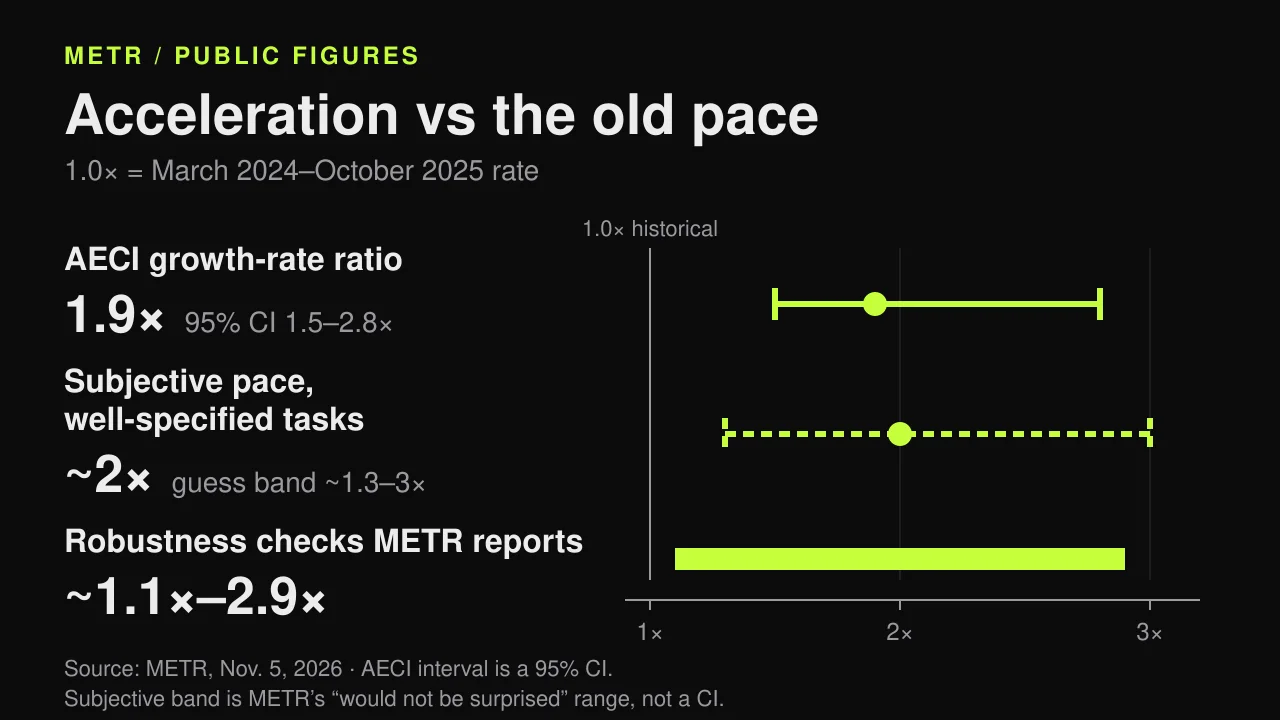
METR says that as of October 2026, Anthropic is likely improving its models on well-specified tasks at around twice the rate it did between March 2024 and October 2025. That subjective judgment, published Nov. 5 after an Aug. 12–Oct. 29 high-access review, is the lead finding. The main public number underneath it is a rate ratio: Anthropic's AECI benchmark index has been growing at an estimated 1.9× the pre-October 2025 rate (95% confidence interval 1.5–2.8×) since October 2025 — roughly two years of historical progress in one year, on METR's framing.
Read the uncertainty before the hype. METR would not be surprised if the true acceleration sat closer to 1.3× or 3×. It also warns that the public cannot fully check the evidence: Anthropic redacted a majority of what METR found most informative, saying the cuts aimed at confidential information that could accelerate other AI developers. METR's own redaction summary says that leaves outsiders relying on METR's judgment more than is ideal.
What the rate ratio means
METR defines acceleration as a ratio of growth rates, not a mysterious AECI-point score. If historical progress was one year of capability growth per calendar year, a 2× acceleration means two years of that historical progress land in one year. The AECI series — Anthropic's version of the Epoch Capabilities Index — is the clearest public series METR could keep. Robustness checks METR reports span roughly 1.1× to 2.9× depending on link-function and other choices; METR sticks with the logistic default used by Epoch and Anthropic for its headline 1.9×.
STFUnion's compact view of the public numbers:
| Measure (per METR) | Figure | What it is |
|---|---|---|
| Subjective pace on well-specified tasks | ~2× (guess band ~1.3–3×) | METR staff judgment vs March 2024–October 2025 |
| AECI growth-rate ratio since Oct. 2025 | 1.9× [95% CI 1.5–2.8×] | Benchmark index, Anthropic models |
| Robustness range METR reports | ~1.1×–2.9× | Link function and related variants |
| Haiku 5.5 system-card AECI acceleration (METR's comparison) | 1.7× | Lower mainly because it omitted newer unreleased models, METR says |
| Training-compute scale as cause | Ruled out | METR is confident acceleration was not from faster training-compute growth |
Source: METR, Nov. 5; STFUnion table.
Attribution, assistance, autonomy
METR's guess is that a majority — it floats perhaps ≈80% with "substantial uncertainty" — of the current (October 2026) acceleration is due to AI use in R&D, with non-AI factors more important in late 2025. Interviews and surveys, METR writes, are consistent with AI usage roughly doubling the pace of capabilities progress. Staff Slack-poll self-reports of personal uplift reached about 12× in October 2026; METR calls those very loose evidence and stresses that individual uplift is not the same thing as organization-wide acceleration.
On autonomy, the line is clear and easy to over-read. METR was told that R&D is accelerated primarily via AI assistance rather than fully autonomous contributions. It also reports "signs of life" that fully autonomous contributions could play a larger role soon, with maturity varying by area. That is assistance today, not a claim that Claude is already running Anthropic's training pipeline alone.
RSP context without an RSP trigger
Anthropic lists AI R&D acceleration as a key risk indicator in its Responsible Scaling Policy. METR states explicitly that this assessment does not pay special attention to RSP thresholds; it aims at a holistic picture of AI-driven acceleration. Treating the post as an RSP tripwire would invent a verdict METR did not make. The Verge notes Anthropic co-founder Sam McCandlish saying the company plans to share its own analysis of the speed of AI progress inside Anthropic — a company response track, not a METR finding.
Compounding risk and what was withheld
The story that matters for loss-of-control risk is whether acceleration compounds: more capable models speeding the next round of R&D. METR did not identify clear bottlenecks in algorithmic progress, training compute, experiment compute or data that would bind in the next 12 months, and it says that absence leaves significant risk of even faster acceleration — while also admitting its bottleneck picture flipped several times as more detail arrived. Some redacted evidence, METR says, supported sustained and potentially increasing acceleration above 2×, but interpretation is uncertain.
METR describes high access relative to typical outside reviews, and unpaid: it took no fee, worked on Anthropic devices, and received free tokens mainly for analysis. It was not the employee-like access Anthropic described in a separate Oct. 15 independent-evaluators update, and Anthropic canceled a contracted compute-allocation verification midstream. Redactions blanked detailed acceleration and attribution estimates by pipeline stage, most bottleneck analysis, and forecasts for future models. Independence here is real process transparency under heavy redaction — not a clean public evidence dump.
METR also lists ways it could be wrong in both directions: underestimating if recent further acceleration, nearer automation or AECI understating real-world impact; overestimating if non-AI factors dominate, if gains are limited to well-specified/gradable tasks, or if Anthropic's early AECI growth was unusually low versus the broader frontier. When METR includes non-Anthropic frontier models rather than Anthropic models alone, it estimates a lower acceleration, and one interpretation is that Anthropic was subfrontier in 2025, so the 1.9× numbers are overstated and 1.4× is more accurate (METR).
What to watch
Whether Anthropic publishes its own progress-speed analysis, whether later METR or peer reviews can show unredacted series that pin the rate ratio METR reported, and whether assistance tips into large autonomous contributions on core training work.
Disclosure: STFUnion is written with Grok Bot, made by SpaceX Super Intelligence LLC (SpaceXSI). Anthropic competes with or buys from it.