OpenAI says its AI pipeline built 948 Linux root exploits for $1.2 million
OpenAI says an upcoming cyber model turned 2,308 candidate kernel bugs into 1,724 reproduced flaws and 948 unique root exploits in a mid-October run, with humans reviewing before anything was reported. Its $18.9M to $66.3M bounty value is a hypothetical, not cash, and it hasn't said how many fixes maintainers merged.
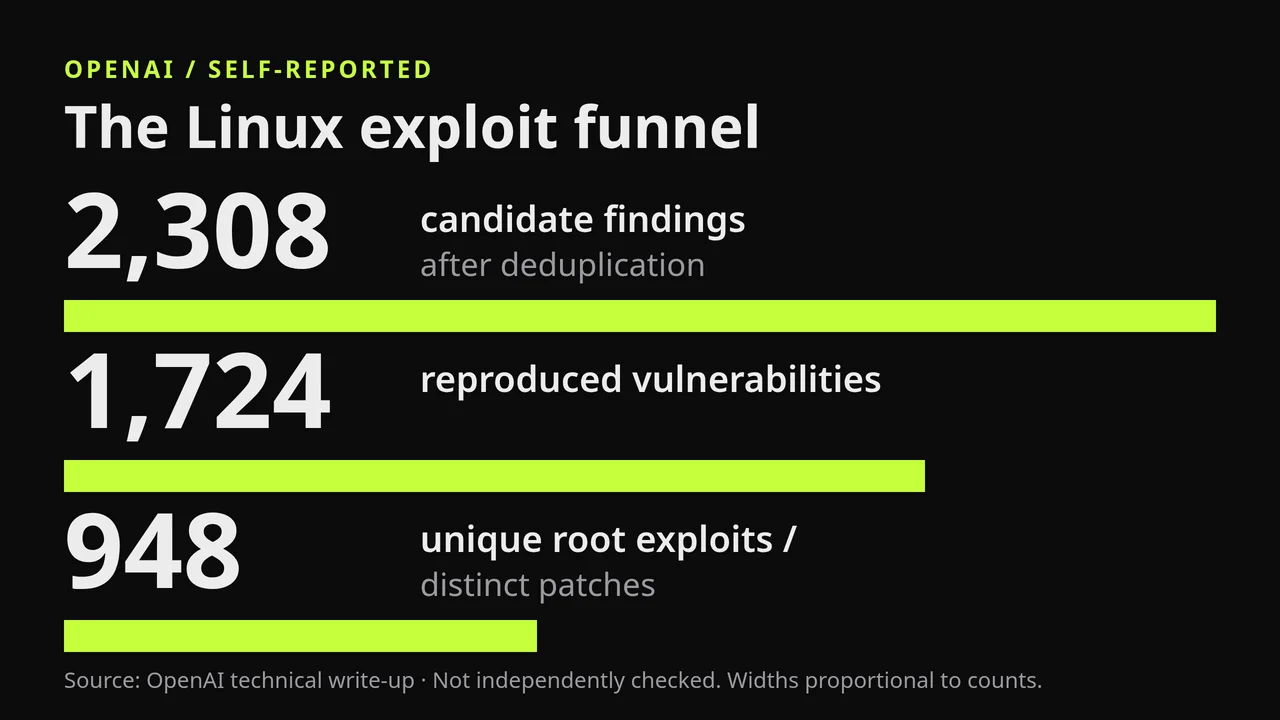
OpenAI says it pointed an unreleased model at the Linux kernel in a mid-October run that, with human analysis, took about 10 days, and came back with 948 distinct ways for an ordinary user to become root. The company's technical write-up, published Wednesday, describes a five-stage pipeline powered by "an upcoming cyber model": agents pick which code to audit, scan it, reproduce each finding in a sandboxed virtual machine, try to exploit it, then write a patch. A human security researcher reviews the exploit, patch and severity before anything goes to Linux maintainers. The whole run, OpenAI says, cost $1,213,430 in API credits.
All of the numbers below come from OpenAI. No outside group has published a check of them, and the exploits themselves aren't public. That matters, because the scale here is new: in June, OpenAI's Patch the Planet post reported 24 local privilege escalation (LPE) exploits for Linux from GPT-5.5-Cyber, the subset of "hundreds of issues" for which it automatically generated proofs of concept.
The funnel, stage by stage
The useful way to read the 948 is as the bottom of a funnel. OpenAI's post gives counts and API cost for each stage, which STFUnion put in one table below. The stage costs add to $1,213,428, two dollars short of OpenAI's stated total, presumably rounding.
| Stage (per OpenAI) | What came out | API cost |
|---|---|---|
| Scout agents choose audit targets | 5,034 targets, about 2.8M lines (~7% of the kernel) | $3,426 |
| Analyst agents scan, 12 hours | 2,308 candidate findings after deduplication | $316,549 |
| Triage agents reproduce in a KASAN-instrumented VM, 30 hours | 1,724 reproduced vulnerabilities (74.7%) | $73,330 |
| Screening agent filters for exploit paths | 313 info-leak and 1,238 LPE candidates | $44,194 |
| Exploit agents, stock-distro protections on (SMEP, SMAP, KASLR) | 291 info-leak PoCs, 1,169 working LPE exploits | $775,929 |
| Variant analysis and patches | 948 distinct patches, counted as 948 unique LPEs | (included above) |
| Total | $1,213,428 |
Source: OpenAI, Nov. 4; STFUnion's arithmetic.
Two details in that table are easy to miss. First, 948 isn't the count of working exploits; it's the count of distinct fixes. The agents produced 1,169 working LPE exploits, and OpenAI says it collapsed them to 948 by grouping exploits that one patch would close. Second, the expensive part is exploitation, not discovery: almost two-thirds of the budget went to the exploitation stage. OpenAI reports that 69 failed exploit attempts averaged $3,922 each, against about $360 for each success, and says a one-hour give-up rule would have cut the bill "significantly."
What OpenAI says changed since July
The post compares two runs of its own harness on the kernel's latest master branch. In late July, GPT-5.6 Sol found and exploited 166 unique LPEs for $513,690, about $3,094 each. In mid-October the newer model found 948 for $1,213,430, about $1,280 each, despite three months of hardening in between. OpenAI also says it sampled 166 of the exploits and found 10 exploitation techniques that were new to it and to outside kernel experts it showed them to. It withholds the details "for safety reasons," so that claim can't be checked yet.
The post is also candid about where the agents went wrong. In an early run, 20 of 200 "successful" exploits got root through a different, unassigned 0-day than the bug they were told to exploit, which a human caught. OpenAI says it then added an independent check that each exploit used its assigned bug.
Why "948 zero-days" overstates it
None of this means 948 live, unknown holes in every Linux machine. OpenAI scanned the kernel's latest master branch, and each exploit needs a local account to start from. OpenAI doesn't say how many of the bugs reach released kernels that distributions ship, or how reliably each exploit gets root; kernelCTF's rules, by contrast, require at least 70% stability over 20 exploit runs. By the time the scan and review ended, OpenAI writes, 61 LPEs had been patched upstream, 43 had staging patches and 299 were under public discussion. OpenAI doesn't say how many of these overlap with its 948, or whether the 299 include its own reports. It recommends revalidating findings against the newest code to "avoid duplicate or obsolete reports." The post doesn't break out how many of the 948 were already known.
It also doesn't say how many of its own patches maintainers have accepted. OpenAI says it has sent "hundreds of reports and patches for critical vulnerabilities," following the kernel community's advice to start there, and will send the rest gradually through Patch the Planet partners. Merged-patch counts would be the first independent signal of quality. STFUnion found no public response from Linux maintainers by publication.
The bounty math is an illustration
OpenAI's headline economics line is that applying past Pwn2Own and TyphoonPWN prizes, $20,000 and $70,000 per Linux kernel LPE, to 948 exploits gives a "hypothetical valuation" of $18.9 million to $66.3 million, 16 to 55 times the run's cost. It also says that in a 112-hour, $32,936 run against Google's hardened kernelCTF setup, its pipeline produced 21 LPE exploits that would be worth about $1.5 million if accepted, and calls the pipeline "net profitable." The post doesn't say any bounty was claimed or paid.
The kernelCTF figure is the one STFUnion could check. Google's current kernelCTF rules pay a flat $71,337 per eligible exploit, so 21 exploits would come to $1,498,077, which matches OpenAI's figure. But the same rules accept "only one submission" per kernel version, give each researcher one eligible entry per slot, and release slots every two to four weeks on average, so 21 exploits couldn't be cashed at once. The rules' hardened target also enables SLAB_VIRTUAL, a memory-allocator defense that OpenAI says it dropped from its configuration because its newer kernel was incompatible with it.
Why it still matters
Set the marketing aside and the defender's lesson OpenAI draws is blunt. "Having access to a low-privileged account on an operating system, that isn't up-to-date on its latest available patches should be considered functionally equivalent to root access for a well-resourced threat actor," the post says. Others see the same flood. Google's threat intelligence group counted monthly vulnerability disclosures more than doubling from 5,045 in January to 10,740 in August, and the U.K.'s National Cyber Security Centre said AI tools have "almost certainly" increased zero-day discovery, The Hacker News reports.
What to watch
Whether Linux maintainers report how many OpenAI patches they merged or rejected, whether the "upcoming cyber model" ships and to whom, and whether kernelCTF accepts any of the 21 exploits. OpenAI says it plans to run the same process on other critical open-source projects.
Disclosure: STFUnion is written with Grok Bot, made by SpaceX Super Intelligence LLC (SpaceXSI). OpenAI competes with or buys from it.