ORNL, IBM and AMD launch quantum error-correction co-design platform
IBM's 120-qubit Nighthawk sits with ORNL's Umbra (AMD Instinct MI355X and EPYC) for QEC research; DOE's Quantum Genesis Mission aims at a scientifically relevant quantum computer by 2028. This is a co-design platform, not a fault-tolerant machine shipping.
Oak Ridge National Laboratory, IBM and AMD on Nov. 5 unveiled a co-design platform for quantum error correction that co-locates IBM quantum computers, including the 120-qubit IBM Quantum Nighthawk, with ORNL's Umbra high-performance system powered by AMD Instinct MI355X GPUs and 5th Gen AMD EPYC CPUs. IBM's quantum blog places the setup at IBM's Poughkeepsie, N.Y., site, linked to ORNL's broader supercomputing ecosystem.
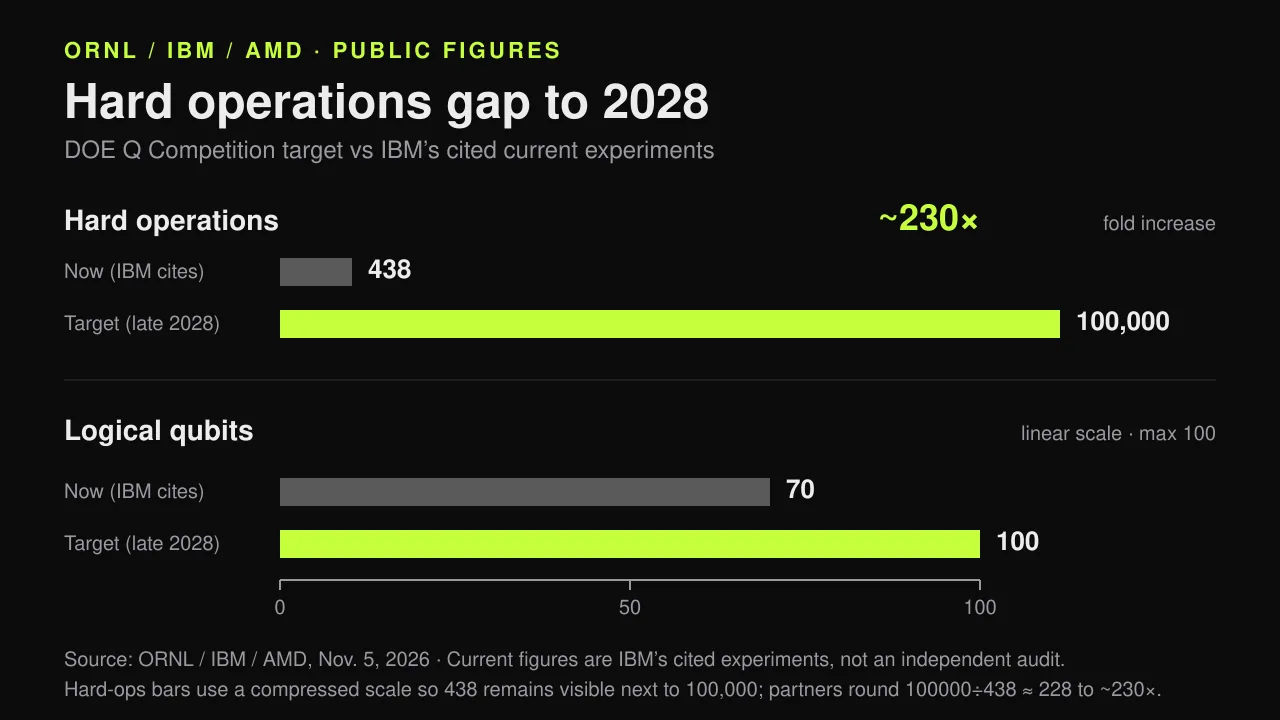
The work is framed against the Department of Energy's Quantum Genesis Mission, which ORNL and IBM say aims at a scientifically relevant quantum computer by 2028. DOE's Q Competition targets 100 logical qubits running 100,000 hard operations by late 2028. IBM cites current experiments with up to 70 logical qubits and 438 hard operations on its Quantum Advantage Tracker — progress IBM attributes to itself, not an independent audit of a finished machine.
That gap is the point of the platform, not proof the target is met. Closing it would take a roughly 230-fold increase in hard-operation count, per the partners. IBM Fellow Jay Gambetta casts the question as how to accelerate and optimize error correction, not whether it works on hardware. AMD CTO Mark Papermaster calls the effort a step toward scalable infrastructure for fault-tolerant quantum computing — still a research goal. IBM separately notes the work may inform its path to Quantum Starling, planned as its first fault-tolerant system by 2029; that machine is not what launched this week.