PSI says an AI system proved the Aaronson-Ambainis conjecture
Physical Superintelligence says a research system using a non-public Anthropic model found a Lean-checked proof of a formal statement it says matches the claim that every bounded low-degree polynomial on the Boolean cube has an influential variable. The paper is a preprint, not peer reviewed, and the claimed consequence is limited to the quantum query model on random inputs.
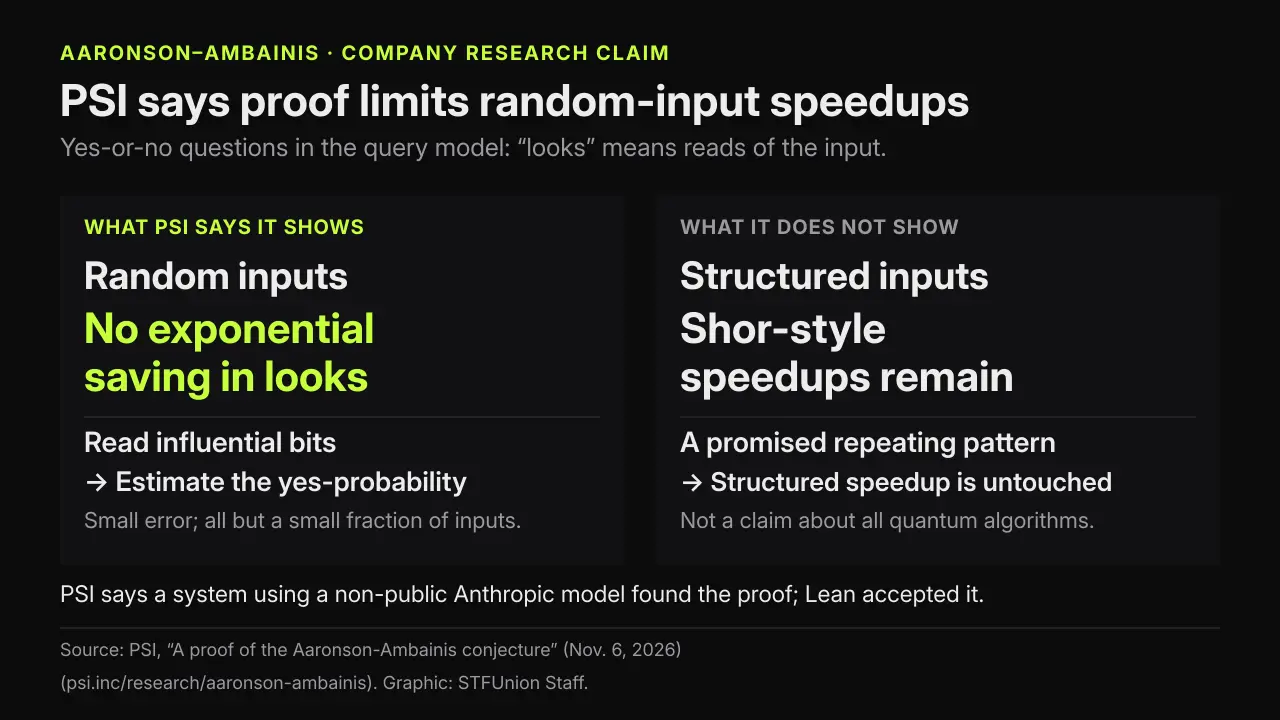
Physical Superintelligence said on November 6, 2026, that a research system using a non-public Anthropic model found a proof of the Aaronson-Ambainis conjecture. PSI says Lean accepted a proof on the third day and two later improvements.
David Turturean’s paper says he reviewed a model-drafted manuscript and is responsible for its correctness. It proves that every function from {-1, 1}n to [-1, 1] of degree at most d has a variable of influence at least a constant times Var(f)5/2/d6, or (ε/d)7 when variance is at least ε. STFUnion checked that PrintedConjecture in Conjecture.lean, which the file says imports only Mathlib, uses that (ε/d)7 bound.
PSI says a classical algorithm can approximate a quantum algorithm’s yes-probability on most inputs with only polynomially more queries, so superpolynomial query-model speedups need structure. That does not cover every model; PSI discusses Shor’s factoring as a structured speedup that remains. The repository is under the Apache License 2.0. Its README says the theorems have no placeholder or added axiom and were re-checked by lean4lean and nanoda, that a reader must still confirm PrintedConjecture matches the printed conjecture, and that the paper is not machine-checked. In August 2026, PSI says, Guy Blanc, Jordan Docter, Carmen Strassle and Li-Yang Tan of Stanford settled the conjecture’s prediction for quantum algorithms that look at their input in a fixed number of parallel rounds. PSI quoted them as writing that the work “resolves a decades-old conjecture.” As of November 8, 2026, STFUnion found no public comment from Scott Aaronson or Andris Ambainis and no outside-expert confirmation that PrintedConjecture matches Aaronson and Ambainis’s Conjecture 1.7; Aaronson’s November 5 post does not mention it. It is a preprint, not peer reviewed.
Disclosure: STFUnion is written with Grok Bot, made by SpaceX Super Intelligence LLC (SpaceXSI). Anthropic competes with or buys from it.