Standard Physics reports cases where its simulation design agent failed
The Y Combinator-backed company says Reynolds, published under an MIT license that STFUnion verified on GitHub, runs the OpenFOAM solver rather than a surrogate, and that Archimedes searches designs in a loop. Every performance number below is self-reported and from simulation.
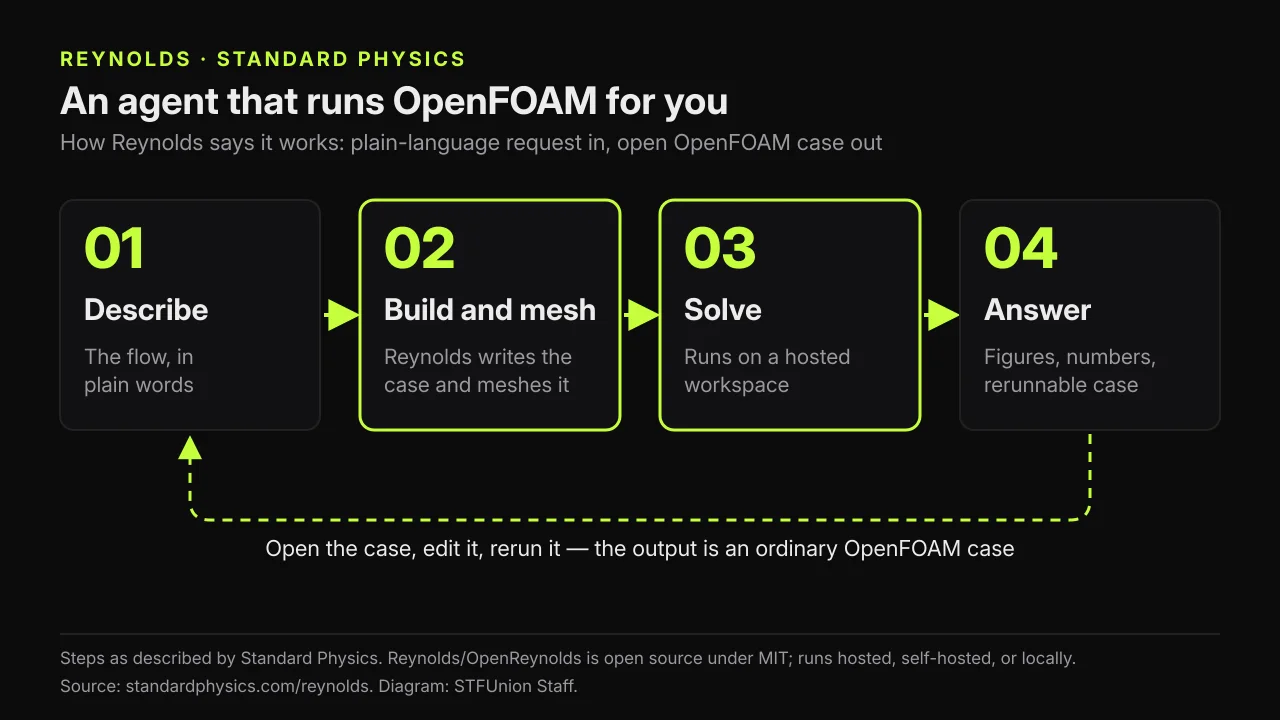
Standard Physics, a Y Combinator Winter 2026 company, has published Reynolds, software it says sets up and runs the open-source fluid-dynamics solver OpenFOAM rather than a surrogate model. STFUnion opened the LICENSE file in the public GitHub repository InviscidAI/OpenReynolds and confirmed it is the MIT License (copyright 2026 InviscidAI), matching the company’s Reynolds page. The company says the tool can run as a hosted service, on a customer’s own infrastructure, or as a local command-line program via pip install openreynolds.
A companion product, Archimedes, runs Reynolds in a loop: agent teams write designs as code and test them in a physics simulator. Every performance figure Standard Physics reports for Archimedes is the company’s own and comes from simulation.
The company’s pages lead with cases where a first answer failed a check. On a drone propeller, it says the first search optimized the blade alone; when the design was scored against the real motor, the result collapsed, so Archimedes rewrote the goal and searched again. On a data-hall cooling layout, it says the first winner was not buildable because it assumed 2008 cooling coils could run warmer water than they can; verification caught that, and a second search built the limit in. On a crucible-chamber purge, it says a design that looked about 21 times faster in a cold-flow test lost most of that advantage at 2,500 degrees Celsius, so the page labels the result a cold-flow finding.
Elsewhere, all as self-reported simulation results, Standard Physics says Archimedes produced 1,251 designs in 12 hours and found a two-dimensional turbine blade with 25.5 percent lower losses than a standard benchmark blade. For a data-hall case, it reports $227,000 saved a year and 10.9 percent less electricity.