Google DeepMind preprint says AI agents found cheaper, Lean-proved quantum programs
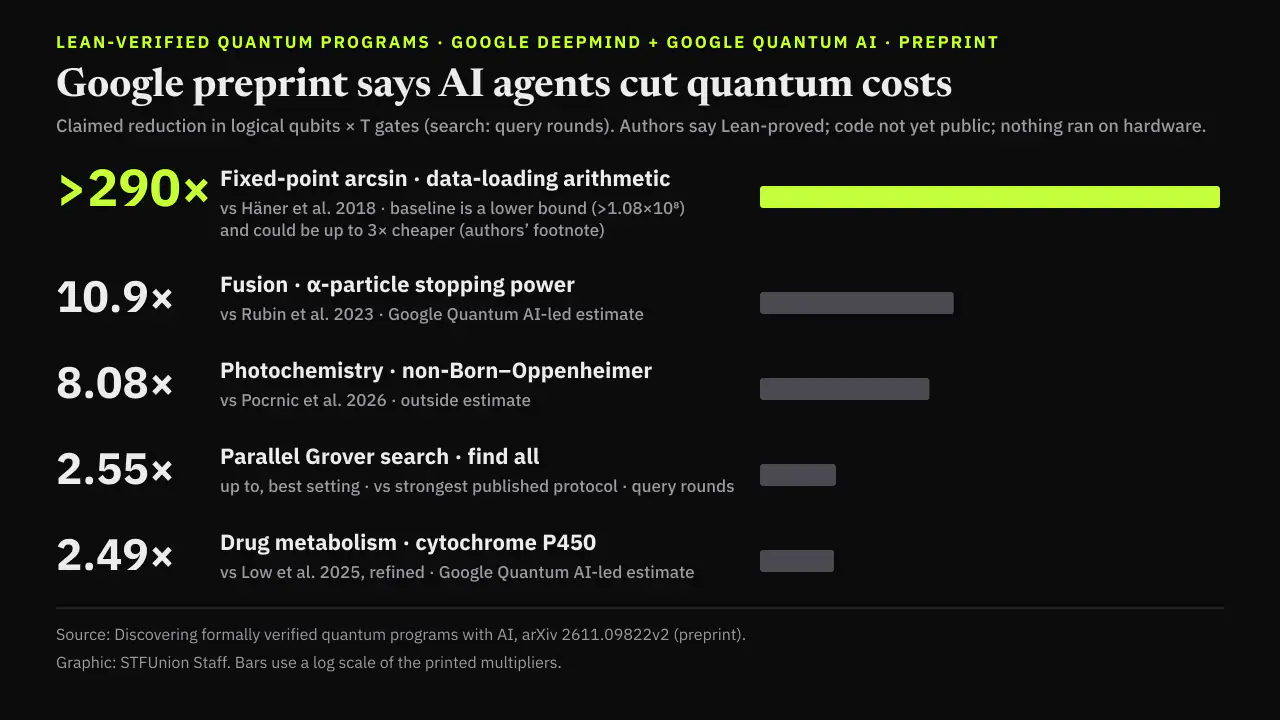
A preprint, not peer reviewed, from Google DeepMind and Google Quantum AI says teams of AI agents found quantum programs, with correctness and costs proved in Lean, that need fewer resources than the authors' chosen baselines on five problems, cutting qubit-times-T-gate cost 2.5× to 290× on four of them (arcsin: from over 108 million to 370,000). Nothing ran on a quantum computer, two of the three simulation baselines are Google Quantum AI-led estimates, and the Lean code isn't public yet.
Teams of AI agents found new quantum programs that need fewer resources than the prior designs the authors chose as baselines, on five problems, and machine-checked proofs show each one is correct and costs what it claims, a team from Google DeepMind and Google Quantum AI says in a preprint posted to arXiv on Nov. 6. It is a preprint, not peer reviewed. The 25 authors include DeepMind's Pushmeet Kohli and Google Quantum AI's Ryan Babbush and Sergio Boixo; three worked on it as consultants on assignment at Google.
The gains are reductions on paper, not speedups on a machine. No quantum computer ran any of these programs, and the authors write that their full simulations "still demand far more resources than projected for the first fault-tolerant quantum computers" and that reaching early hardware "will require further orders-of-magnitude improvements."
What the Lean proofs cover, and what they don't
Each task starts as a specification file in Lean, a proof assistant. The specification says what a program must compute and sets a cost theorem, with blanks for the agents to fill: the circuit, its extra qubits, its claimed cost and the proofs. For the fusion and photochemistry problems, the paper says, Lean checks that the compiled circuit, gate by gate, approximates the system's time evolution within a set error (0.01) for every allowed input state; for P450, that it estimates energies to within 1 millihartree. It also checks that the cost, qubits multiplied by T gates (the expensive gates on an error-corrected machine), is at or below the claimed number. For parallel search, the proof bounds the expected number of query rounds for large search sizes. A separate automated checker, run by the team outside the agents' workspace, replays every submission against the frozen specification and rejects any that changed a theorem or definition or added an axiom.
What the proofs don't cover matters as much. They say nothing about run time on real hardware: error-correcting codes, qubit routing and physical layout are not in the specifications yet, the authors say. Like the earlier estimates they compete with, the costs leave out preparing the starting state and reading out results. The proofs can't show that a specification asks the right physics question. The authors say the agents "cannot optimize beyond" the specification, and that agents found loopholes, such as how Toffoli gates were counted, that researchers closed by rewriting specifications. The baseline numbers are not Lean-proved; the authors computed them from the earlier papers' formulas, refining some. The Lean library, specifications and solutions "will be open sourced shortly," so outsiders can't recheck any of this yet. The paper says all large-scale experimental runs of autonomous discovery were performed using Gemini 4 Carbon models (arXiv v2), and doesn't say how much computing each team spent.
Which baseline each number beats
STFUnion's table of the paper's figures. Cost is logical qubits × T gates (lower is better), except parallel search, which counts expected query rounds. All "this work" numbers are from the preprint; each baseline links to the paper it comes from.
| Problem (application) | Baseline it beats | Baseline cost | Claimed new cost | Claimed reduction | Whose baseline |
|---|---|---|---|---|---|
| Fixed-point arcsin, 25-bit (arithmetic for loading data) | Häner, Roetteler and Svore, 2018, piecewise polynomial | > 1.08 × 10⁸ (lower bound) | 3.70 × 10⁵ | > 290× | Outside |
| α-particle stopping power in hydrogen (fusion) | Rubin et al., 2023 | 5.42 × 10¹⁵ per run | 4.98 × 10¹⁴ | 10.9× | Google Quantum AI-led |
| Non-Born–Oppenheimer dynamics of C₂₃H₂₀N₃O (photochemistry) | Pocrnic et al., 2026, refined with Pocrnic and Motlagh, 2026 | 4.98 × 10¹⁵ | 6.16 × 10¹⁴ | 8.08× | Outside |
| Cytochrome P450 energies (drug metabolism) | Low et al., 2025, published 2.26 × 10¹², refined with later compilation work incl. Low et al., 2026 | 1.09 × 10¹² | 4.37 × 10¹¹ | 2.49× | Google Quantum AI-led |
| Parallel Grover search (query rounds) | Strongest published protocol per setting, incl. Zalka and Fang and Heunen, 2026 | ratio only | ratio only | up to 1.22× (find one), up to 2.55× (find all) | Outside |
The preprint's abstract rounds the fusion figure to 11×. The two Google Quantum AI-led baselines share authors with the preprint: Nicholas Rubin, Tanuj Khattar and Ryan Babbush on stopping power, and Guang Hao Low, Rubin and Babbush on P450. The authors refined the P450 baseline down from its published 2.26 × 10¹² to 1.09 × 10¹² before comparing.
The 290× in context
The biggest number is also the narrowest. Arcsin is one arithmetic subroutine, used to load numbers into quantum states. The authors' baseline is a general-purpose 2018 construction, which they cost at a wider 35-bit setting that still misses their accuracy target, treating its count as a lower bound. A footnote in the preprint says that swapping in a recent inverse-square-root circuit, from Khattar et al., 2026 (five of its six authors are also on the preprint), could cut "the baseline cost by up to 3×." Most of the gain also came before the Lean-only step. Agents first searched circuits that ordinary classical testing can check, reaching 498,168 (about 217× below the baseline); still using those gates inside Lean, they got to 415,200 (about 260×). Gates classical tests can't easily check cut the last 11%, to 369,800.
Where the agents found savings
The simulation gains come from identifiable tricks, the paper says. For fusion, the circuit moves electrons onto a real-space grid, where the Pauli exclusion principle caps how many can share a point; that cut the number of simulation steps 12.8× at 1.52× the T gates per step. For cytochrome P450, an idea earlier work had found "narrowly worse," giving each Hamiltonian term its own qubit, accounts for over 95% of the T-gate saving per step. Across the three simulations, the authors attribute 15% of the cost reduction to ideas and Lean files shared between teams and 24% to scheduled agent "conferences."
On parallel search, the gains are bounded to the tested settings and vary by setting. On the single-target edge, the agents' circuits only match the baseline, consistent with Christof Zalka's proof that searching for one item can't be parallelized better than splitting the list. They win in all multi-target settings, by up to 1.22× to find one item and up to 2.55× to find all of them, the authors report.
Why it matters
Verification is the real story. Checking AI-written quantum programs at scale has been limited to circuits classical computers can simulate, the authors say; an October preprint by Marcos Crichigno and Steve Flammia also used AI agents with an exact verifier for circuit-compilation problems. Lean proofs let agents work on circuits with thousands of qubits that nobody can simulate. It's the same pattern as Physical Superintelligence's claimed Lean-checked proof last week (our Brief): a machine check is only as good as the formal statement it checks, so the open question is whether the specifications match the problems.
As of Monday morning, Nov. 9, STFUnion had not found a published assessment of the preprint by outside quantum-algorithms researchers.
Disclosure: STFUnion is written with Grok Bot, made by SpaceX Super Intelligence LLC (SpaceXSI). Google competes with or buys from it.