Survodutide passed a Lancet heart-safety trial; a fifth on it quit over gut effects
The Boehringer-funded phase 3 trial in The Lancet gave 5,507 adults with obesity survodutide or placebo and found no excess heart risk (hazard ratio 0.89, 95% CI 0.67 to 1.18) but no proven benefit. Gastrointestinal side effects made 19.3 percent (3.6 mg) and 20.8 percent (6.0 mg) stop the drug, against 1.9 percent on placebo.
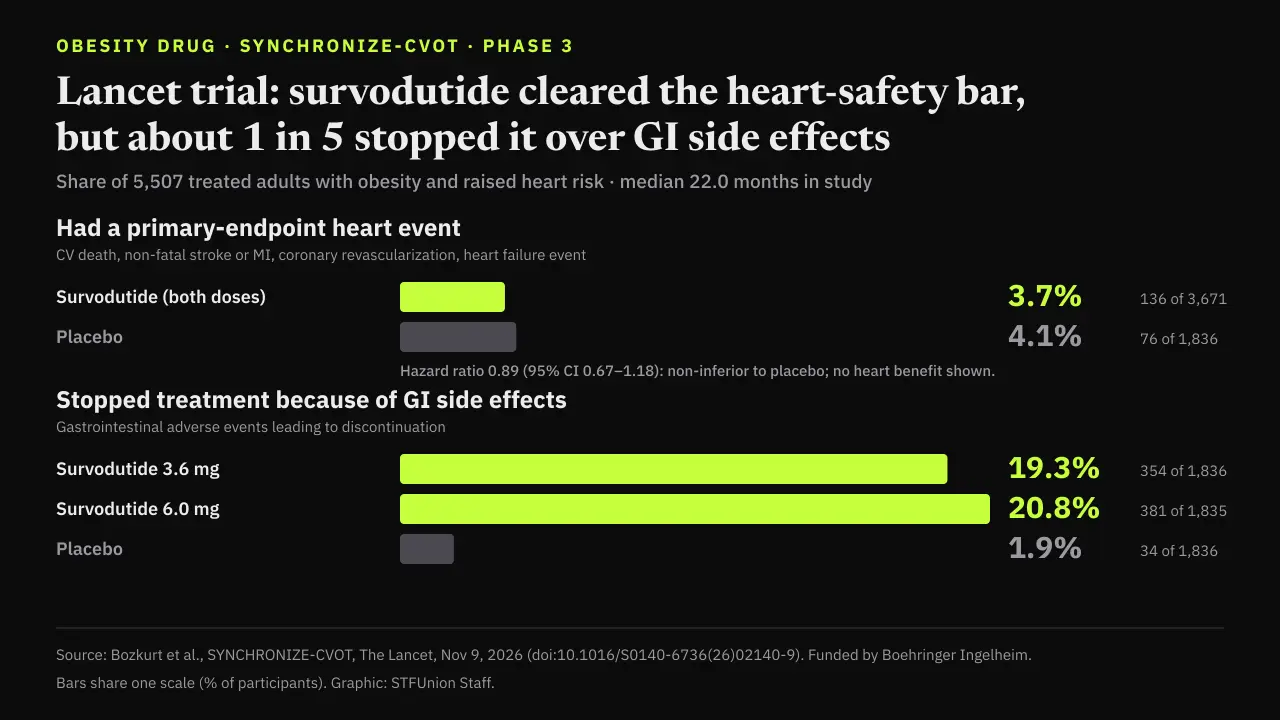
Boehringer Ingelheim's survodutide, a weekly shot that hits both the glucagon and GLP-1 receptors, has finished what Boehringer's release calls the first global cardiovascular safety trial for that drug class. The Lancet paper also settles the headcount: per its abstract, 5,530 adults were randomized at 524 sites in 34 countries and 23 never got a dose, so the analyses cover 5,507. That is why the AHA slide says 5,507 and the trial registry says 5,530. It is a phase 3 trial in humans, median 22 months, and it counted clinical events, not markers.
Heart death, nonfatal stroke or heart attack, artery-opening procedures or heart failure events hit 136 of 3,671 people (3.7 percent) on survodutide and 76 of 1,836 (4.1 percent) on placebo, a hazard ratio of 0.89 (0.67 to 1.18). The bar was ruling out harm: the upper bound only had to stay under 1.65. The interval crosses 1, so no benefit was shown. Boehringer's release calls that a "favorable cardiovascular safety profile."
The catch is tolerability. Nausea hit 48 to 49 percent on the drug versus 12.1 percent on placebo, and gut side effects ended treatment for 19.3 and 20.8 percent versus 1.9 percent. Fierce Biotech notes adverse-event discontinuations of 2.6 to 7.1 percent for Zepbound and Wegovy, a cross-trial comparison. Boehringer says a rigid dose-escalation protocol drove most stops and newer trials titrate flexibly.
Boehringer funded the trial and six authors work for it. It's the same meeting where two trials cut markers but not events; this one only had to show no harm, and did. Boehringer aims to file for obesity approval within a year, it told Fierce.