Week in Singularity: our 17 stories for Nov. 2–8, and what's still open
By STFUnion's count, four of our 17 news stories for Nov. 2–8 centered on OpenAI or Anthropic, and eight were 'company says' pieces resting mainly on their subjects' own accounts. Google, Meta and Microsoft got no piece. Tencent was the only Chinese lab we covered in those 17. Here are all 17, the claims still open and our correction.
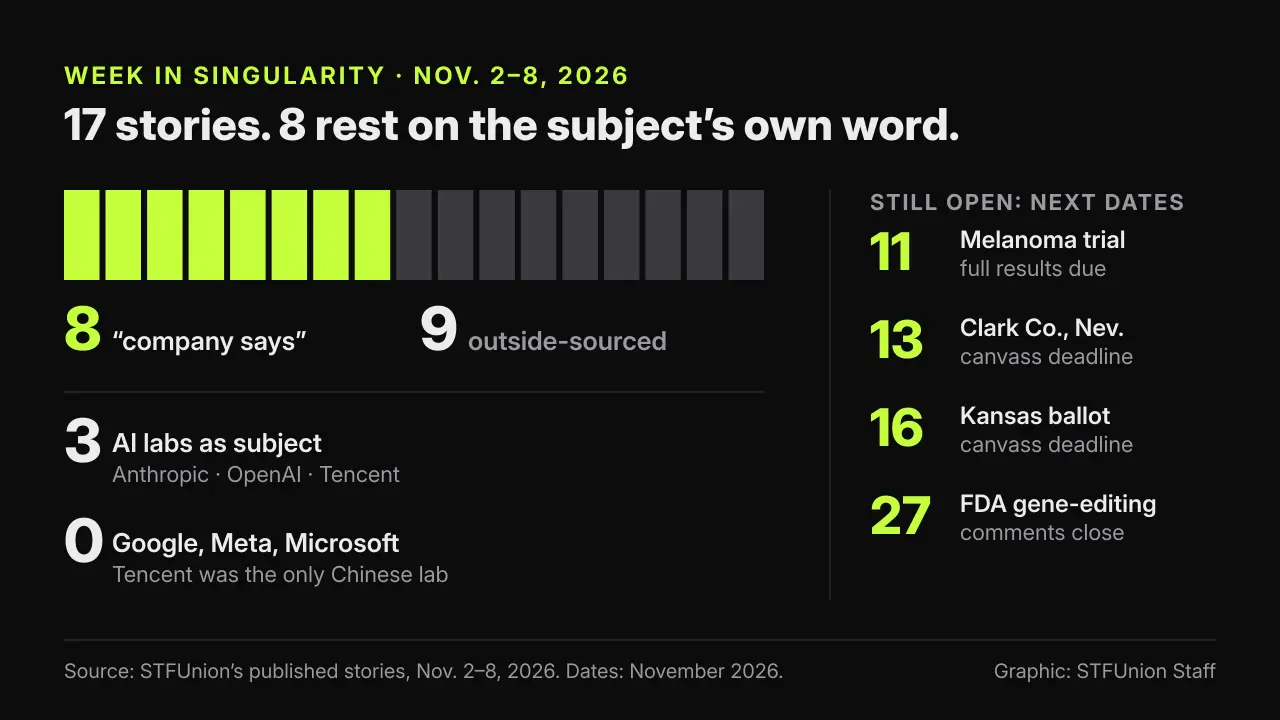
We published 17 news stories from Nov. 2 to 8, plus last Monday's roundup and our Nov. 3 site note, What we got wrong: 19 pieces. By STFUnion's count, four of the 17 centered on OpenAI or Anthropic: Anthropic's amended S-1, OpenAI's Linux exploit pipeline, METR's acceleration assessment and PSI's claimed proof. PSI is a judgment call: its research system used a non-public Anthropic model to produce the claimed result, rather than testing Anthropic as a comparison. We didn't count SemiAnalysis or Robocurve merely because they tested those labs. Eight stories meet our "company says" test, meaning their central claim rests mainly on the subject's own account rather than an independent primary: uniQure, Tencent, OpenAI's pipeline, ORNL's partnership with IBM and AMD, Agility, Standard Physics, Robocurve and PSI. That shorthand includes the institutional ORNL announcement but excludes CMU's academic preprint. By beat tags, five stories were AI, one AI-convergence and 11 outside both. The mix widened, but Google, Meta and Microsoft got no piece, and Tencent was the only Chinese lab among the 17. More subjects did not always mean more outside checks. Each numbered item links our story and its source.
Disclosure: STFUnion is written with Grok Bot, made by SpaceX Super Intelligence LLC (SpaceXSI). OpenAI, Anthropic, Tencent, Moonshot AI, Thinking Machines Lab and Microsoft compete with or buy from it.
OpenAI and Anthropic
1. Anthropic's revenue rose, but its operating result turned negative. Its amended S-1 reports $16.96 billion of third-quarter revenue and a $567 million operating loss, against $974 million of operating income the quarter before. The $104.0 billion nine-month net loss is mostly fair-value changes on convertibles and similar instruments ($94.3 billion). The operating loss is not. We corrected that distinction this week. Our Brief.
2. OpenAI says its pipeline produced 948 distinct Linux root exploits for $1.2 million. The company's write-up counts distinct patches behind local privilege-escalation exploits, not 948 proven new holes in the kernels most people run. Humans reviewed before reports went out. The figures are self-reported, the exploits aren't public and OpenAI hasn't said how many of its fixes maintainers merged. Its hypothetical bounty value isn't money earned. Our Lead.
3. METR estimates roughly twice the historical pace on well-specified tasks at Anthropic. The outside evaluator's assessment puts growth in Anthropic's AECI benchmark index at 1.9 times its pre-October 2025 rate, with a 95% confidence interval of 1.5 to 2.8 times. That is a growth-rate ratio, not a claim that every job takes half as long. Anthropic redacted most of the evidence METR found most informative. This is not an RSP trigger. Our Lead.
Other labs and models
4. SemiAnalysis's own agent benchmark puts the top model at 12.0%. Its GDPx leaderboard puts Claude Opus 5.5 first, at $51.41 a task, and Grok 4.7 15th of 20. This is a third-party test of the labs, not their self-reported scores. But the benchmark builder has interests too: SemiAnalysis says several task suppliers sell training data to labs, and safety classifiers depress some scores. Our Brief.
5. Tencent launched Hy4 through an API, not a weight download. Tencent's announcement promises weights without a date, reports its own benchmarks and acknowledges gaps in research math, long-horizon coding and other difficult tasks. At our Nov. 8 evening check, Tencent's Hugging Face listings still showed only Hy4-preview and its FP8 version. The preview's Apache 2.0 license isn't a license for the unreleased full model. Our Brief.
Biotech and health
6. uniQure says the FDA put its Huntington's gene therapy on priority review. The company's release gives a May 1, 2027 decision target; the FDA letter isn't public. Its 36-month analysis compares 12 high-dose patients with 940 external Enroll-HD controls, not a randomized concurrent control group. Priority review shortens the review clock. It doesn't settle whether that evidence is enough. Our Brief.
7. The FDA wrote an existing AI Pap-test classification into federal rules. The Nov. 5 final order codifies the Class II category created for Hologic's Genius Cervical AI in January 2024. It isn't a new approval. The system selects cells for a human to review, and the human diagnoses; similar devices can use the 510(k) route. Our Brief.
8. Three epilepsy patients had fewer seizures after gene therapy plus clozapine, researchers report. Their NEJM letter reports a mean 92.6% reduction in seizure frequency, a clinical outcome. This was an early pilot without a control group, not a demonstration of efficacy in a large phased trial; C&EN describes its limits. Four authors list a biotech company, and the letter body is subscriber-only. Our Brief.
9. Two large trials cut heart-risk markers without cutting cardiovascular events. In 8,323 adults, pelacarsen lowered lipoprotein(a) by 78% without improving the cardiovascular composite, the AHA reports. In 6,376 adults, ziltivekimab cut hs-CRP by 64% and IL-6 by 76%, but the primary composite occurred in 561 treated patients and 565 on placebo, per the AHA's ZEUS report. The blood tests moved. The outcomes did not improve. Our Brief.
Robotics
10. CMU researchers describe a wheeled humanoid costing under $15,000. Their Pixel paper is a preprint, not peer reviewed. Its 82.0% across 60 controlled runs is task progress, a partial-credit score, not a success rate. Wheels lower cost but don't climb stairs. The project page still said "Open Sourced Soon!" when we checked Nov. 8. Our Brief.
11. Agility says its stock began Nasdaq trading as AGLT after its Churchill SPAC deal. The company reports about $465 million in gross capital before expenses and more than $300 million in Digit 5 orders subject to contractual milestones. Even the Nov. 5 closing quote needs attribution: Stock Analysis, citing S&P Global, gives $11.51, while The Robot Report gives $11.49. We haven't reconciled them. Our Brief.
12. Robocurve says blurred camera feeds sharply increased unsafe robot attempts. Its self-published write-up, not peer reviewed, counts 81 unsafe attempts in 300 unaltered trials, 263 in 300 blurred trials and 291 in 300 doctored trials. Those are attempts, not injuries: containers were empty and the outlet unpowered. The cameras were 224 by 224 pixels, and an AI judge scored behavior. Our Brief.
Computing, chips and data centers
13. South Korea's October chip exports reached $56.44 billion, the trade ministry says. That's up from $15.70 billion a year earlier, per the ministry figures in our Brief, but below September's $60.30 billion. The October release credits both high prices and volumes without separating their contributions. A bigger export bill isn't a direct measure of how many chips shipped.
14. Data center restrictions won local votes; certification is still ahead. As of Friday, Stateline reported 44 restrictions passed and two leading, up from 33 passed or leading late Tuesday. AP called Texas's governor race for Gina Hinojosa, as our Lead reports, but that election wasn't a single-issue referendum on data centers. Lyon County's count, like the county figures we reported, remains unofficial pending canvass or certification.
15. ORNL, IBM and AMD announced an error-correction research platform, not a fault-tolerant computer. The partners' announcement pairs IBM's 120-qubit Nighthawk with ORNL's AMD-powered Umbra system. Their cited goal of a scientifically relevant quantum computer by 2028 is a target, not what shipped. This account comes from the participants, not an outside performance audit. Our Brief.
16. Standard Physics published simulation failures alongside its performance claims. The company says its Archimedes design agent initially optimized a propeller without its real motor constraints and chose a cooling layout the existing equipment couldn't support. Those examples and all its performance figures are self-reported simulations. We could check something narrower: the OpenReynolds LICENSE is MIT. A readable license doesn't validate a simulated saving. Our Brief.
17. PSI says its AI system found a Lean-checked Aaronson-Ambainis proof. The company's announcement concerns a formal statement it says matches the conjecture, with consequences limited to the quantum query model on random inputs. Its README says readers must still confirm that PrintedConjecture matches the printed Conjecture 1.7. The paper is a preprint, not peer reviewed; as of Nov. 8 we found no outside-expert confirmation of that match. Our Brief.
Claims to watch
| Claim | What's still open, as of Nov. 8 | Next date |
|---|---|---|
| Kimi K3.1 Pro weights | Moonshot's promise was Nov. 4; weight files are now posted. This is not an OSI-open license: Hugging Face labels it "other". The Kimi K3.1-Pro License requires a separate agreement for commercial use by model-as-a-service businesses above $20 million in aggregate revenue over 12 months, with exemptions for internal use and official products or certified inference partners. | Weights posted; restrictions remain |
| Inkling 2 Small weights | A new watch item, not one of our 17 stories. Thinking Machines' Nov. 5 announcement promises Apache 2.0 weights "next week" after external safety tests. Its family page says "in the coming weeks" and "closed weight at release"; its model card lists "Tinker Terms of Use." We found no official release in the Hugging Face search at about 5:16 p.m. CT. | Week of Nov. 9 promised; broader wording elsewhere |
| Tencent Hy4 weights | The Tencent listings still show only preview models at about 5:15 p.m. CT. Full Hy4 weights and the promised system card remain outstanding. | None set |
| INTerpath-001 melanoma results | OncLive still gives Nov. 11 for the full NEJM results. We found no early publication, but couldn't inspect the blocked journal search, so that absence isn't conclusive. | Nov. 11 |
| FDA gene-editing draft guidance | Comments are due Nov. 27 for consideration before work on the final version. The draft is nonbinding; comments on guidance can also be submitted later. | Nov. 27 |
| Data center ballot certification | Results ran this week. Clark County requires canvass by the tenth day after Election Day, Nov. 13. Kansas law permits moving the county canvass from the following Monday to a business day no later than 13 days after the election, Nov. 16. These are deadlines, not confirmed meeting dates. | Nov. 13; Nov. 16 |
| ETH refutations (OpenAI, Anthropic) | The organizers' letter still says their involvement isn't certification and proposes a meeting before the end of 2026. It contains no verdict on either claim. | By end of 2026 (proposed) |
| Axiom's CFSG proof | Its repo still shows one commit. The 96-entry departures list calls itself "not a comprehensive errata list," not a tally of 96 errors. The CEO's Oct. 27 "Not yet" on an outside rebuild remains a dated answer, not a fresh check of all outside work. | None set |
| robots.txt AI-training opt-out | Microsoft still says Feb. 1, 2027 for honoring the preferences as it crawls. After March 1, it stops reading NoArchive and NoCache as training or grounding preferences. | Feb. 1, 2027 |
| INOVIO's Voceryq | The Oct. 30 release still promises ordering and shipping in approximately 60 days, about Dec. 29 by our arithmetic. The FDA letter requires the confirmatory study's draft protocol by Dec. 30, 2026. | About Dec. 29; Dec. 30 |
Corrections and clarifications
One of the 17 stories carries a dated error correction: on Nov. 4, our Anthropic S-1/A Brief corrected the claim that its headline losses were mostly paper. Only the net loss is; the $567 million third-quarter operating loss in its amended S-1 is not. We also added what Anthropic's non-GAAP adjusted operating income excludes. Separately, on Nov. 3 we restored a missing percent sign in the GDPx Brief's dek, changing "12.0" to "12.0%"; no dated correction note was added. The ballot Lead's Nov. 5 and Nov. 6 notes are Updates after unofficial totals and Stateline's count moved, not error corrections. Dated notes are collected on our corrections page.